






Choosing between a 3-cylinder and a 4-cylinder engine can be a key factor when buying a car, as each has its unique strengths. The 3-cylinder engine is lightweight, fuel-efficient, and ideal for city driving, while the 4-cylinder engine offers more power and smoother performance, making it better suited for longer trips and highway driving. In this blog, we’ll break down the differences between these engines, covering fuel efficiency, power output, and best use cases to help you decide which option fits your driving needs best.
Comparison between 4-cylinder and 3- cylinder
| Feature | 4-Cylinder Engine | 3-Cylinder Engine |
| Power Output | Generally higher power output is due to an additional cylinder. Suitable for larger or performance-oriented vehicles. | Lower power, often enough for compact or economy cars. |
| Smoothness | Smoother operation due to balanced power delivery. | Slightly more vibration; needs balance shafts for smoothness. |
| Fuel Efficiency | Good fuel efficiency, but is a little lower than a 3-cylinder due to extra weight and friction. | Higher fuel efficiency due to fewer moving parts and lighter weight. |
| Weight and Size | Heavier and larger, occupying more space in the engine bay. | Lighter and more compact, allowing for better use of space. |
| Cost | Often more expensive due to additional parts and complexity. | Typically cheaper to produce and maintain. |
| Applications | Common in sedans, SUVs, and performance cars. | Ideal for compact, fuel-efficient city cars. |
What is a 4 cylinder engine?
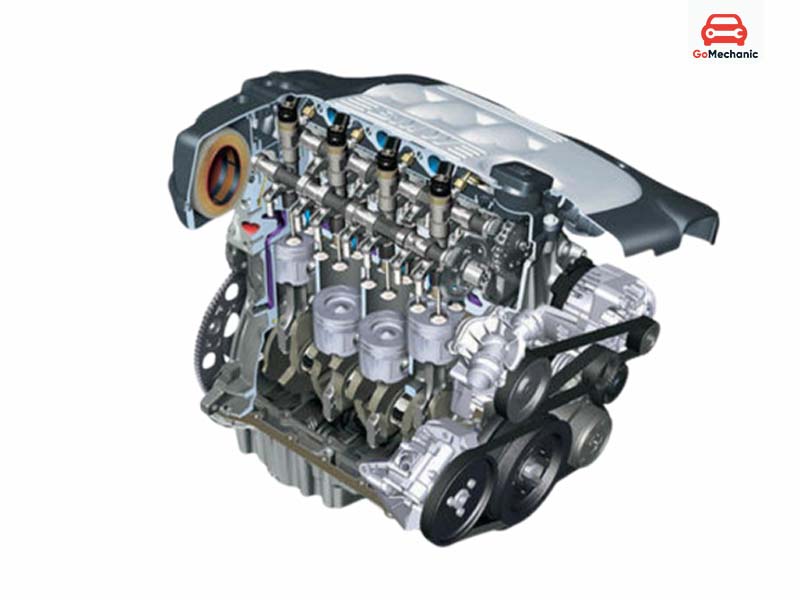
A straight 4 cylinder engine is an engine that has four cylinders arranged at 90 degrees to each other. The 4 cylinder engine design is a normal size design commonly found in automobile engines. This engine generally consumes less amount of fuel than engines with larger cylinders for example an eight or a six cylinder engine. Generally, all engines convert chemical energy in fuel to heat; rather than converting heat energy to mechanical work.
Elements of a 4 Cylinder Engine
- Cylinders and pistons: The primary parts that allow for the power generating combustion of the gas mixture.
- Crankshaft: It is the part which rotates the crank and converts the radial and axial figure movement of the pistons into the angular motion required to rotate the wheels.
- Camshaft: Operates the timing of the intake and exhaust valves for the engine.
- Fuel Injectors: inject necessary fuel into appropriate cylinders.
- Spark Plugs: These are responsible for burning the fuel air mixture.
- Exhaust System: Assists in getting rid of the gases produced during the combustion process from inside the engine to the surrounding atmosphere.
Working of 4 Cylinder Engine
- Intake: The stage in which the piston is free to move within the chamber filled with air-fuel mixture due to the opening of the intake valve.
- Compression: After the phase of intake there comes the stroke when the intake valve shuts and a piston inside the cylinder compresses stored gaseous fuel.
- Combustion: At the upper part of the cylinder which is somewhat closed there is a mixture of air and fuel which is planted with a spark plug to initiate combustion and push down the cylinder.
- Exhaust: This involves the opening of the exhaust valve part to allow the escape of the gases that have filled in the cylinder head cavity.
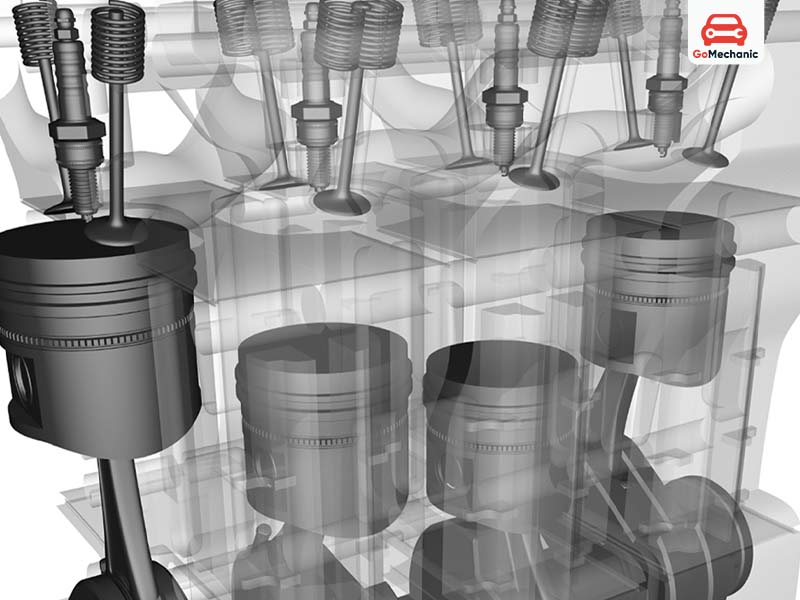
These four stages occur in each cylinder in a fixed order, which assists in maintaining an uninterrupted power supply. Most of the 4-cylinder engines are found in straight or inline engine layouts meaning the cylinders are in a single line and not placed in separate banks or rows
Pros And Cons of 4 Cylinder Engine
| Pros | Cons |
| Fuel-efficient | Lower power than larger engines |
| Smooth operation | Slightly less fuel-efficient than 3-cylinder |
| Compact and lightweight | Not ideal for high-performance needs |
| Lower emissions | Can vibrate under heavy load |
| Versatile for various car types | Heavier than 3-cylinder engines |
Why would you opt for a 4 cylinder engine?
Individuals with long distance and busy roadway commutes who need more power for manoeuvring or maintaining higher speeds for longer distances will benefit more from the power and smoothness of a 4-cylinder Diesel engine.
What is a Three Cylinder Engine?
The phrase ‘straight-3 engine’ describes the configuration of a three cylinder piston engine where all the cylinders are situated within the same crankcase. It is widely known that this type of motor is not as widely used as the more popular 4-stroke engine however 3 cylinder engines can be found in a range of vehicles including cars and motorbikes. Their crankshaft angle is at the position of 120 degrees. Hence, their firing intervals have equal distribution.
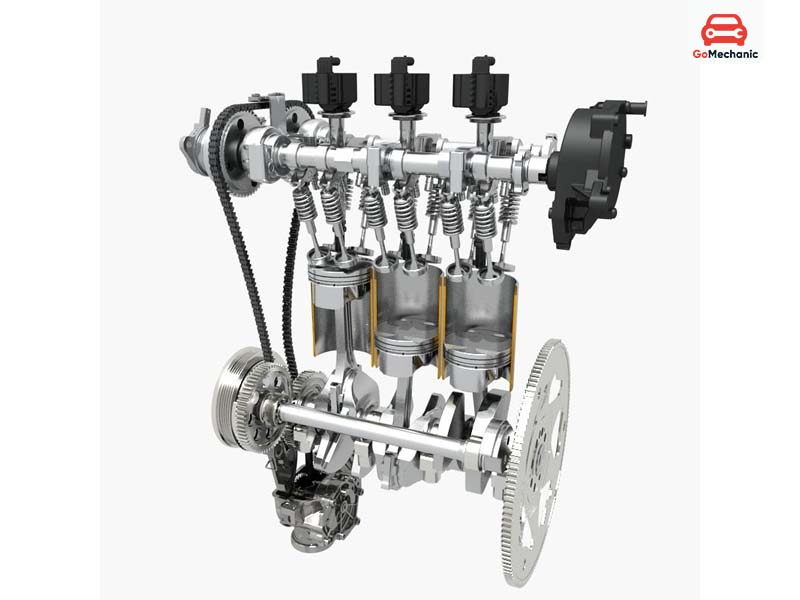
Elements of Three-cylinder engine
- Cylinders: The cylinder and piston assembly is the basic unit in which a Combustible mixture is burned to produce work.
- Crankshaft: It is the component that converts the straight movement of vertical pistons into a rotational motion for an attached wheel found within the crankcase.
- Camshaft: It is a part that operates the opening and closing of the intake and exhaust valves in an engine.
- Fuel Injectors – Fuel injectors introduce the necessary energy into each primary cylinder.
- Spark Plugs: An automotive spark plug is an earthing component of the ignition system of any engine that works on a cyclic combustion process of any gas or vapour, allowing a high voltage electric spark to ignite the gas trapped within a cylinder.
- Exhaust System: This system directs away the combustion byproducts from the vehicle which are produced by the internal engine mechanisms through various processes of combustion.
Working of a Three-Cylinder Engine
- Intake: The intake valve of the cylinder opens to allow a venturi effect to draw the air-fuel mixture into the cylinder.
- Compression: The intake valve closes, and the piston moves up to compress the mixture.
- Combustion: The spark plug ignites the compressed mixture of air and fuel gas resulting in an explosion which forces the piston down thereby creating work.
- Exhaust: The exhaust valve of the cylinder opens allowing any combustion gases that may be present to leave the cylinder.
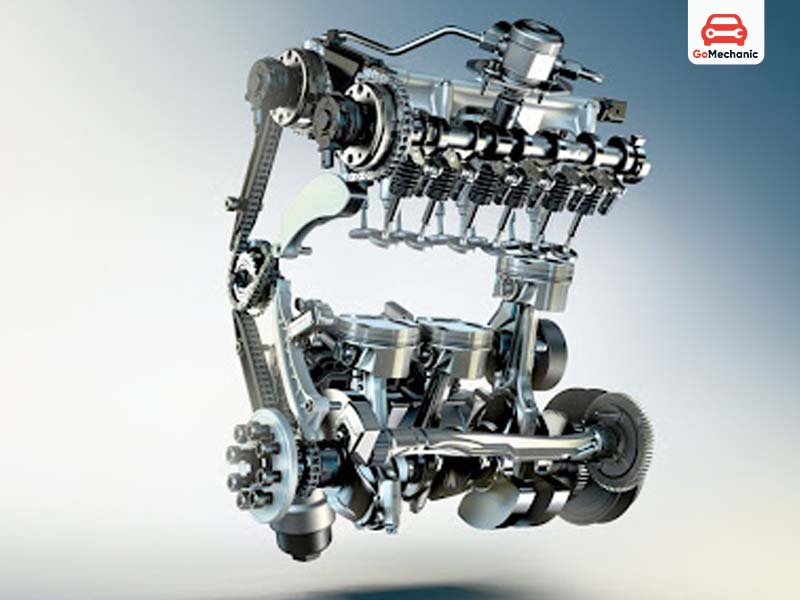
Every component and every cylinder of these engines undergoes a process that comprises, occurs and is coordinated in a number of stages. The three-cylinder motors will be subjected to more torsional vibrations than the 4 cylinder motors since they have one less cylinder, but they will most likely be more compact and effective. Most of the 3-cylinder motor engines are also designed as in-line with the cylinders positioned in a single row.
Pros And Cons Of 3 Cylinder Engine
| Pros | Cons |
| Higher fuel efficiency | Lower power output |
| Lightweight and compact | More vibration, less smooth |
| Lower emissions | Limited to smaller, city-focused cars |
| Cost-effective | Less suited for high-performance needs |
Reasons to choose a three-cylinder engine?
It is suitable for shorter distances and best for those who are more fuel efficiency-focused than performance. Vehicles which are powered by a three-cylinder engine are more affordable and are thus suitable for rational individuals.
Preferred 4 Cylinder and 3 Cylinder Cars in India

Popular 4 Cylinder Engine Cars
- Maruti Suzuki Ertiga
- Tata Nexon
- Toyota Glanza
- Mahindra XUV 700
- Mahindra XUV 3X0
- Hyundai Exter
- Maruti Suzuki Exter
- Hyundai Grand i10
- Maruti Suzuki Baleno
Popular 3-Cylinder Engine Cars
- Tata Altroz
- Maruti Suzuki Wagon R
- Renault Kwid
- Tata Tiago
- Maruti Suzuki Celerio
- MG Astor
- Kia Sonet
- Maruti Suzuki Fronx
- Skoda Kylaq
- Tata Punch
Check This Out- Top 10 Most Selling Cars In The Third Quarter 2024
Which Engine Cylinder Is Best?
A three-cylinder engine is best for someone who values fuel efficiency, affordability, and environmentally friendly designs such as city drivers and also budget users. However, a 4 cylinder engine is suitable in situations where more engine performance and quick acceleration are needed especially when driving on highways.
It is essential to the customers’ driving experience to understand that the decision to choose a three-cylinder engine instead of a four-cylinder can also influence the way the driver will handle the car. Hence, the choice between a three and a four cylinder engine is strictly determined by the individual’s needs and concerns driving-wise.
Also read- 3 Cylinder vs 4 Cylinder Engine: Performance, Efficiency, Maintenance
FAQs
1. Which sounds better, a 3-cylinder or a 4-cylinder?
A 4-cylinder usually sounds smoother. The firing order is evenly spaced, so the engine note settles into a steady rhythm. A 3-cylinder, by design, has a slight imbalance. You hear it more at idle. It is not unpleasant, just more mechanical. Some drivers notice it immediately. Others stop paying attention after a few minutes.
2. Is a 3-cylinder engine good for long drive?
Yes, it can handle long drives without reliability issues. Modern engineering has solved most durability concerns. The difference shows in refinement. At sustained highway speeds, mild vibrations may become noticeable. It will cruise. Just not as effortlessly as a larger engine.
3. What are the disadvantages of a 4-cylinder engine?
A 4-cylinder is smoother, but it is also slightly heavier. More components mean more internal friction. In smaller cars, that can affect fuel efficiency. It may also increase cost. The gain is refinement. The trade-off is marginal efficiency.
4. Are 4-cylinder cars good or bad?
They are generally well balanced. Power delivery feels linear. Acceleration is predictable. For mixed city and highway use, they work without drama. That consistency is the reason they remain common.
5. What are the disadvantages of a 3-cylinder car?
The limitation is balance. With fewer cylinders, vibration cannot be fully eliminated. At low speeds, the engine can feel coarse. Under load, smoothness drops slightly. It performs adequately. It just does not hide its mechanical nature.


