






Electric vehicles are no as rare as they once were. In cities like Delhi, Bangalore, and even Tier-2 towns like Indore or Kochi, you’ll now spot EVs weaving through traffic with confidence. Among those, two EVs that stand out are the MG ZS EV and the BYD Atto 3. On paper, both are compact electric SUVs aimed at urban Indians with a growing taste for clean energy, tech-forward cabins, and good ol’ practicality. But once you dig deeper, you realise they come from two very different thoughts. MG, with British roots, leans towards familiarity, while BYD (Build Your Dreams), the giant from China, brings its EV-native DNA to the table. The goal of this comparison is simple: give you every meaningful detail that matters when you’re actually going to live with one of these.
Comparison of Aspects – MG ZS EV vs BYD Atto 3
A. Price Comparison
| Variant | MG ZS EV | BYD Atto 3 |
| Base Variant | ₹17.00 lakh | ₹24.99 lakh |
| Top Variant | ₹20.50 lakh | ₹33.99 lakh |
MG plays the affordability card. The ZS EV undercuts the Atto 3 by a good ₹7–8 lakh at the base level. And if you’re already calculating EMIs in your head, that difference is not small. The Atto 3, meanwhile, confidently sits in the higher price band. But it’s also not trying to be the cheaper alternative. It’s offering a premium experience built around performance, design, and its EV-first platform.
So is the Atto 3 overpriced, or is the ZS EV worth the extra cut? Hold that thought. Let’s get into the engineering and the facts.
B. Dimensions and Chassis Design
| Specification | MG ZS EV | BYD Atto 3 |
| Length | 4323 mm | 4455 mm |
| Width | 1809 mm | 1875 mm |
| Height | 1649 mm | 1615 mm |
| Wheelbase | 2585 mm | 2720 mm |
| Boot Space | 448 L | 440 L |
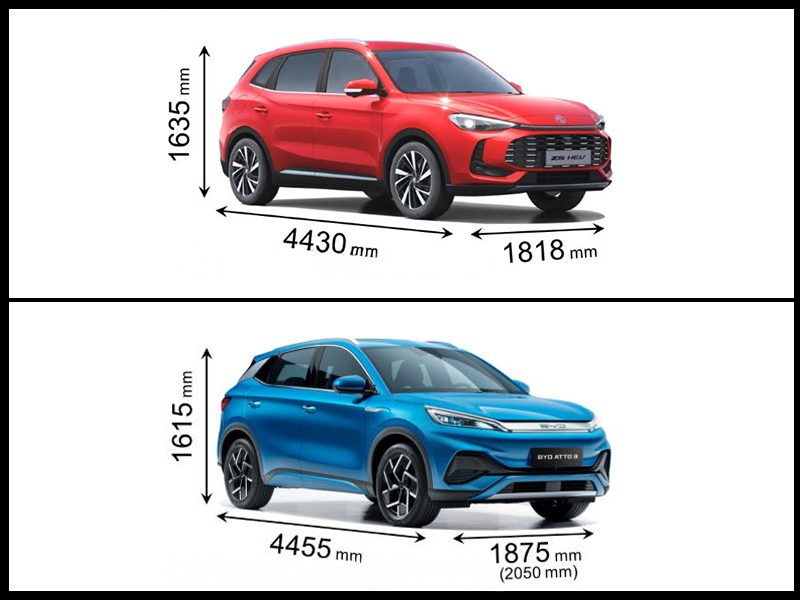
Dimensionally, the Atto 3 is bigger in almost every direction except height, where the ZS EV emerges as the winner. That long wheelbase on the BYD means you get more legroom at the rear. Not a deal-breaker for most, but you feel it when you sit back with your knees poking the seat ahead.
What really separates the two is platform engineering.
- BYD Atto 3 rides on the e-Platform 3.0, which is a dedicated EV architecture. That means the chassis was designed from scratch to accommodate a battery. You get better weight distribution and lower centre of gravity.
- MG ZS EV, on the other hand, is adapted from an ICE platform. It’s not bad at all, but if you’re used to the grounded feel of EVs like the Hyundai Ioniq 5 or even the Volvo XC40 Recharge, you’ll notice the ZS is less cohesive on uneven roads.
C. Charging Time, Network & Warranty
Let’s talk about how long these take to charge, how easy it is to find a charger, and what happens if something goes wrong.
- MG ZS EV (50.3 kWh battery):
- Fast Charging (50 kW DC): 0–80% in 50 minutes
- Home Charging (AC 7.4 kW): 8.5–9 hours
- BYD Atto 3 (60.48 kWh battery):
- Fast Charging (80 kW DC): 0–80% in 50 minutes
- Home Charging (AC 7 kW): 10 hours
So charging times are almost similar for fast charging, despite Atto 3’s larger battery. AC charging is slower for BYD because of the larger juice tank.
Network-wise, MG has a wider reach in India right now. Tie-ups with Tata Power and their own charging station rollout give it a better presence in Tier-2 cities. BYD is catching up but lags in this department, especially outside metro cities.
Both offer an 8-year warranty on battery. Both MG and BYD give 5 years on their car. In short, it’s a tie here.
D. Powertrain, Performance & Range
| Specification | MG ZS EV | BYD Atto 3 |
| Battery Capacity | 50.3 kWh | 60.48 kWh |
| Motor Output | 176 PS / 280 Nm | 204 PS / 310 Nm |
| 0–100 kmph | 8.5 sec | 7.3 sec |
| Claimed Range (ARAI) | 461 km | 521 km |
| Real-World Range | 340–370 km | 380–410 km |
Now here’s where things get a little exciting.
The BYD Atto 3 moves like a beast. That instant torque delivery feels like something a segment above. It picks up speed with genuine conviction and stays composed even at highway speeds.
The ZS EV is smooth, predictable, and absolutely fine for urban and semi-highway use. But when you push it to the limits, there’s a split-second of softness before it surges. Which is fine, unless you’re switching over from a high-torque diesel or love rapid overtakes.
In terms of range, the Atto 3’s bigger battery and newer platform give it a real advantage. Even with AC and city traffic, it holds 380 km easily. The ZS needs more cautious driving to stay above 350.
E. Interior and Exterior Design
Let’s talk comfort and cabin experience first.
MG ZS EV’s interior is functional, friendly, and familiar. Leatherette seats, digital cluster, and a floating touchscreen (10.1 inch) that’s easy to get used to. Great for first-time EV users or those upgrading from compact SUVs like the Creta or Seltos.
BYD Atto 3’s cabin, though, is bold. The rotating 12.8-inch touchscreen, the guitar-string door pockets, and the layered dashboard give it a futuristic, almost playful vibe. But make no mistake, it feels premium. You touch the materials and they’re soft where it matters. Even the air purifier feels more ‘built-in’ than added.
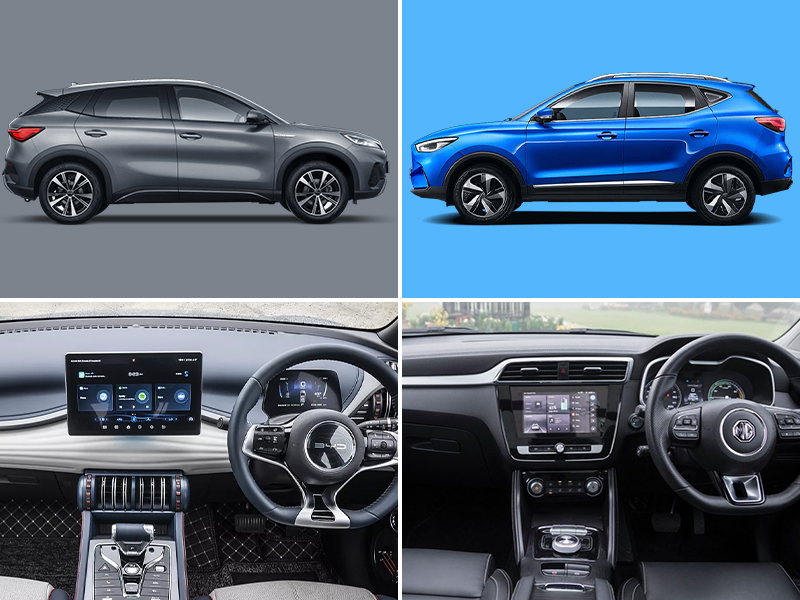
Exterior-wise, both go full SUV mode.
- ZS EV has a cleaner design. New-age MG family grille, arrowhead DRLs, and functional roof rails.
- Atto 3 looks edgier. The tail-light bar, the blade-like DRLs, and its overall stance make it look slightly taller and more dynamic. People notice it, especially when it’s parked next to an old-school ICE SUV.
F. Ride Quality & Safety Features
Let’s start with the Global NCAP/Bharat NCAP ratings, because badges and power numbers mean nothing if the cabin can’t protect you.
1. Crash Test Ratings
- MG ZS EV: Rated 5-stars by Euro NCAP (the petrol variant’s base platform tested). MG has stated that structural integrity remains consistent in the EV. Not yet tested by Bharat NCAP.
- BYD Atto 3: Scored 5 stars in the ANCAP (Australasian NCAP) tests. Solid adult occupant protection, high child safety scores. While ANCAP and Bharat NCAP are not identical, the Atto 3 clearly prioritizes safety.
So both perform well, but BYD has an edge in documented crashworthiness for the EV variant specifically.
2. Safety Features Comparison
| Feature | MG ZS EV | BYD Atto 3 |
| Airbags | 6 | 7 |
| ADAS (Level 2) | No | Yes |
| Lane Keep Assist | No | Yes |
| Adaptive Cruise Control | No | Yes |
| Blind Spot Monitoring | No | Yes |
| Tyre Pressure Monitor | Yes | Yes |
| Rear Camera | Yes | Yes |
| 360-Degree Camera | Yes (top-end) | Yes |
| Electronic Stability Control | Yes | Yes |
This part’s simple: BYD Atto 3 is loaded. The difference in features is not subtle, especially in the ADAS department. If you’re used to driving a Honda City or a Hyundai Tucson, you’ll find BYD’s suite genuinely helpful on long drives or during tricky overtakes.
MG, while solidly equipped, skips ADAS. You do get all the essentials: ESC, HSA, 6 airbags, TPMS, but the extra layer of semi-autonomous safety is missing.
You might find this interesting – BYD Seal: A Comprehensive Analysis of Its 5-Star Safety Ratings
Real-World Ride Experience
MG ZS EV drives like a well-damped urban SUV. In city traffic, it feels light. The suspension leans toward comfort, so the impact from speed bumps and (annoying) potholes is absorbed with grace, especially at lower speeds. However, above 100 km/hr, you’ll feel slight vertical movement. That’s the ICE-platform compromise peeking through.
BYD Atto 3 feels tighter and more connected to the road. Its EV-dedicated platform gives it better weight balance, and that reflects in cornering and highway behaviour. The ride is slightly firmer, but still not uncomfortable. It simply feels more confident at higher speeds.
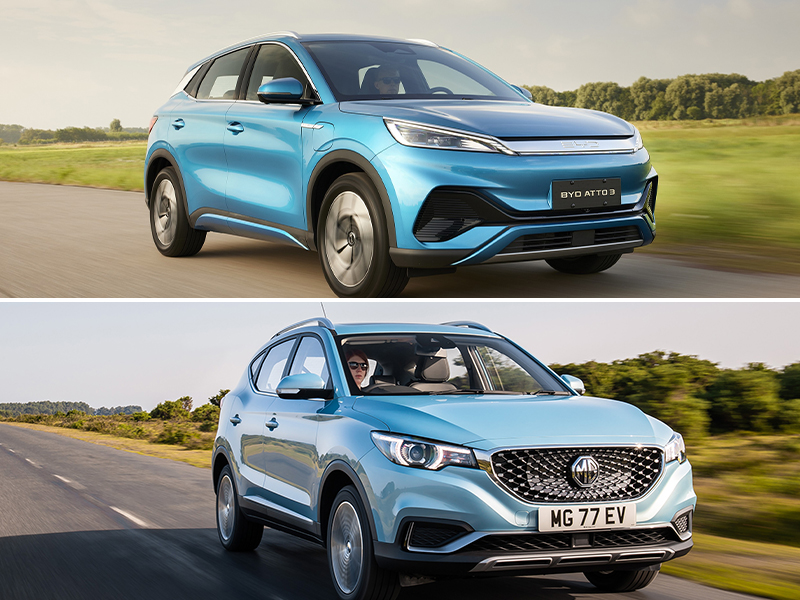
In short:
- If your drives are mostly short, intra-city, comfort-focused, MG will keep you satisfied.
- If you frequently hit expressways or enjoy the fast drive as much as the destination, BYD feels more mature.
And no, neither car makes noise. But the Atto 3 isolates the cabin slightly better when trucks pass by honking like the world’s ending.
Conclusion: So, MG ZS EV or BYD Atto 3?
Here’s the truth: both cars do what they are meant to, and they do it well.
- MG ZS EV offers a fantastic balance between price, practicality, and ease of use. It’s for buyers who want their first EV experience to be smooth and affordable enough to make sense against a diesel Creta or an ICE Nexon EV.
- BYD Atto 3 is for someone who wants an EV because it’s an EV. A tech-oriented, well-built machine that feels like it belongs to the future. It’s more expensive, yes, but it also feels expensive.
Your final decision should come down to this:
- Do you want to spend less but get a well-rounded, slightly familiar package? Go ZS EV.
- Or do you prefer to spend more and get a future-forward experience with more features, range, and composure? Then it’s Atto 3 all the way
That said, you don’t have to stop here. This segment is heating up faster than an EV battery on a Delhi summer afternoon. Take a look at the Hyundai Kona Electric, or even stretch a bit for the Volvo XC40 Recharge if luxury is on your mind. Your perfect EV is out there, just make sure it drives your way.
Fun Reads – The BYD Atto 3: BYD’s Cheapest Car You Can Buy in India, 2025
FAQs
- Which is best, BYD, MG or Tesla?
If we’re comparing in a global sense, Tesla takes the crown on software, Supercharger access, and sheer EV dominance. But in India? Tesla’s not even in the race yet. No official sales, no service network, and no Supercharger infra. So unless you’re importing a Model 3 and treating it like royalty, it’s not practical.
Now between BYD and MG, the real contest starts. BYD has better EV-native engineering (their blade battery tech is serious stuff), longer range, more modern interiors, and real-world finesse. MG ZS EV is more affordable, easier to live with, and has stronger service reach.
- Which is better, MG or BYD?
India’s EV crowd tends to lean towards BYD Atto 3, especially among users who value global reviews, battery confidence, and long-distance comfort. The general sentiment is: “If you’re paying ₹25L+, might as well go full premium.” The Atto 3’s interior quality and quirky design win points too.
But when budget and practicality come into the picture, especially in Tier-2 city subreddits, MG ZS EV gets the yes. Users mention that MG’s wider charging network, easier service, and more grounded cabin make it feel like a safer pick for Indian conditions.
- What is the common problem in MG ZS EV?
The most commonly reported issue with the MG ZS EV in India is range inconsistency. ARAI says 461 km, but in real life – especially with AC on in traffic – you’re likely getting 320–350 km tops. That’s decent, but it throws off first-time EV buyers expecting Tesla-like numbers.
- Is BYD Atto 3 worth buying in India?
If you’re shopping above ₹25 lakh for an EV, the BYD Atto 3 is absolutely worth a test drive. It feels like a car built as an EV from day one, not an ICE conversion. Ride quality is mature, range is impressive (approximately 400 km real-world), and interior quality is best in class.
- How much does it cost to fully charge a BYD Atto 3?
The BYD Atto 3 has a 60.48 kWh battery. Assuming you’re charging it at home (residential rate ₹8/unit), a full charge costs about ₹480 – ₹500. In real-world terms, that ₹500 gets you 380 – 400 km of range.
Want to Compare More Cars? Read these:
- MG Comet EV vs Tata Punch EV – Complete Comparison
- Innova Crysta vs Kia Carens – A Comparison for Your Next Garage Fit.
- A Detailed Comparison Between –Tata Tiago vs Renault KWID
- Maruti Suzuki Grand Vitara Vs Honda Elevate – Complete Car Comparison
- Nexon EV vs XUV400 Detailed Electric SUV Comparison
- Venue vs Nexon – Compact SUV Comparison
- Kia Seltos vs Skoda Kushaq Detailed Comparison for SUV Buyers


