






Every time you take your car out, you notice something when you look out the window. EVs are becoming more and more common on the road. Although they provide particular challenges, they are also essential to creating a more sustainable and sustainable world.
This is where hybrids come in. Not everyone can switch to a full EV right away and that’s fine. A hybrid is the middle path. It gives you the familiarity of a petrol car with the added efficiency of an electric motor working quietly in the background. You don’t plug them in, you don’t change your habits, but you still save fuel and reduce emissions.
So what exactly is a hybrid electric vehicle in India? Think of it as a petrol car that has learned a smarter way to drive. It still has the engine you’re used to, but an electric motor steps in to share the work. At low speeds the motor can move the car on its own, when you need more power the engine takes over, and most of the time both work together. You don’t have to do anything different, yet you’ll notice fewer fuel stops and lower emissions compared to a regular petrol car.
And that’s what this guide is about. A clear look at hybrid electric vehicles. What they are, how they work, the different types you’ll find in India, their prices, and how they compare with petrol cars and EVs. We’ll also touch on something most blogs leave out, the rollout of E20 petrol, and why it makes hybrids a safer pick for Indian buyers in the years ahead.
What Is a Hybrid Electric Vehicle & How Does It Work?
A hybrid electric vehicle is not just a petrol car with an extra motor. It’s built so the engine and motor share the load in real time. At the base you still have an internal combustion engine, usually petrol in India. Along with it sits an electric motor and a battery pack. The motor doesn’t need to be plugged in anywhere because the battery keeps charging while you drive, either from regenerative braking when the car slows down or directly from the engine when there’s extra power available.
On the road this plays out in a few clear ways. In slow-moving traffic, the motor can move the car quietly for short distances, which is where most fuel is usually wasted in a normal petrol car. When you pick up speed or need more push, the petrol engine steps in. If you overtake or climb a flyover, both the engine and motor work together to give a stronger pull. When you brake, instead of losing all that energy as heat, part of it flows back into the battery. This loop keeps repeating, which means less fuel is burnt every day.
Compared to an EV, you don’t ever look for a charger or change your daily routine. Compared to a petrol car, you save money at the pump because the motor keeps recycling energy that would otherwise be lost. And because the system is always balancing itself, you get smoother acceleration and quieter starts that make city driving less tiring.
Types of Hybrid Electric Vehicles
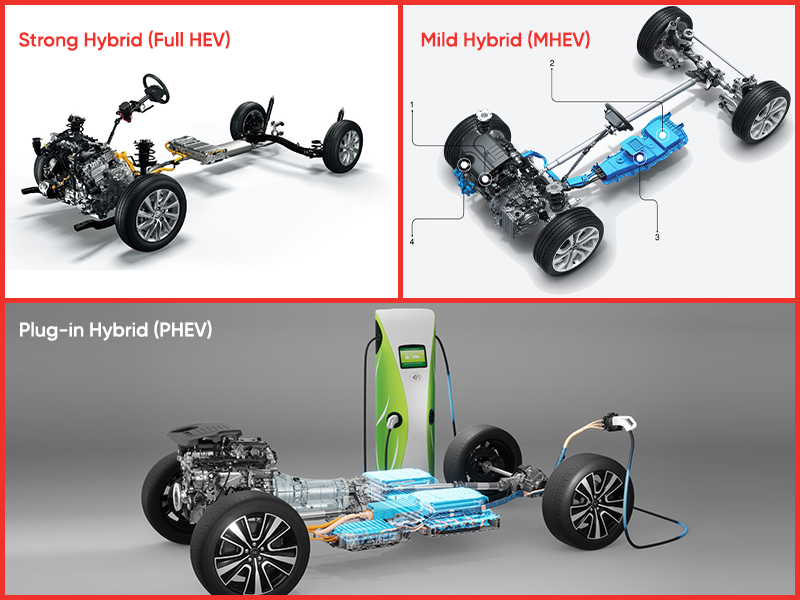
There isn’t just one kind of hybrid. There are three main types you’ll see in India and globally.
1. Mild Hybrid (MHEV):
Uses a small motor and battery to assist the engine during acceleration, run start-stop smoothly, and power basic functions. It can’t drive the car alone but still improves fuel efficiency by around 8–10% in city traffic. Seen in Maruti’s Smart Hybrid models.
2. Strong Hybrid (Full HEV):
This is the real deal. A petrol engine works with a big enough motor and battery to move the car at low speeds on electric power. Toyota Hyryder, Honda City e:HEV are examples.
3. Plug-in Hybrid (PHEV):
A bigger battery lets you drive 30–80 km only on electricity, but you must plug it into a charger. Not many in India yet, but globally they’re popular.
For India, strong hybrids make the most sense right now. They fit traffic patterns, don’t need chargers, and still deliver double-digit mileage gains.
Why Are Hybrid Electric Vehicles Important in India?
- They cut fuel costs. A hybrid City or Grand Vitara can deliver 20–27 km/l, while petrol versions hover around 15–16.
- They fit traffic. Stop-go jams give hybrids more chances to save energy.
- They run clean. Fewer litres burnt equals lower tailpipe emissions.
- They don’t need charging points. Just refill petrol like always.
They’re already tuned for E20 petrol. This matters because India is rolling out 20% ethanol-blended fuel everywhere. Regular petrol cars can lose efficiency. Hybrids handle it better, and that’s one edge most people miss when comparing options. If you want to go deeper, here’s a detailed breakdown of the most expensive Honda car in India, the City Hybrid eHEV.
Others Read – Most Expensive Honda Car in India in 2025 – The City Hybrid eHEV
Specs, Ratings & Prices of Hybrid Cars in India
| Model | Mileage (ARAI) | Battery Warranty | Price Range (₹ lakh) |
| Honda City e:HEV | ~26.5 km/l | 8 yrs / 1.6 lakh km | 19–20 |
| Toyota Urban Cruiser Hyryder | ~27 km/l | 8 yrs / 1.6 lakh km | 16–20 |
| Maruti Grand Vitara HEV | ~27 km/l | 8 yrs / 1.6 lakh km | 16–20 |
| Toyota Innova Hycross HEV | ~21.1 km/l | 8 yrs / 1.6 lakh km | 25–30+ |
| Lexus ES 300h | ~22.5 km/l | 8 yrs / 1.6 lakh km | 63+ |
Key takeaways:
Hybrids come with long battery coverage, so worry about replacement costs is low.
Real-world mileage is slightly lower than ARAI but still way ahead of petrol-only cars.
Prices are higher, yes. A Grand Vitara petrol starts near 10.5 lakh, while the hybrid begins at 16 lakh. But when you calculate annual fuel savings (₹25,000–₹30,000 for average city driving), the gap closes faster than people think.
Safety is comparable to petrol models. Battery packs are well-integrated and tested for Indian conditions.
How Hybrids Compare With Petrol Cars and EVs?
- Petrol vs Hybrid: A regular petrol car costs less to buy but gives you lower mileage, usually around 14–16 km/l in city conditions. A hybrid costs more upfront, but because it can deliver 20–27 km/l, your ownership over five years often turns out cheaper if you drive regularly.
- EV vs Hybrid: EVs are cleanest but depend on charging points. Hybrids give you freedom from range anxiety. For people who can’t install a charger at home, hybrids make sense today.
- PHEV vs Hybrid: Plug-in hybrids sound perfect but without charging discipline, they behave like heavy petrol cars. India isn’t ready yet in terms of charging infra, which is why strong hybrids sell better.
E20 fuel rollout will quietly shift the game in favour of hybrids. EVs don’t care about petrol quality. Regular cars might lose efficiency. Hybrids tuned for E20 keep their advantage.
Understanding the differences for EV and HEVs – EV Cars Vs HEV Cars | What Works In India?
Future of Hybrid Electric Vehicles in India
The future of hybrid electric vehicles in India is not about replacing EVs, it’s about bridging the gap until charging networks, battery prices, and infrastructure mature. Strong hybrids are already playing that role. The next few years will only make them more visible on Indian roads.
- Policy Shift: If GST rates on hybrids get revised from the current 43 percent down to something closer to EV levels, hybrid prices will drop significantly and demand will shoot up. States like Uttar Pradesh already cut road tax for hybrids, other states may follow.
- Local Manufacturing: Maruti and Toyota are localising hybrid parts. Battery plants are being set up in Gujarat and other states, which will reduce costs and make hybrids more affordable.
3.CAFE Norms: Carmakers have to meet stricter fuel efficiency rules by FY27. Hybrids give them super credits, which means more models are expected to launch.
- E20 Fuel Readiness: With E20 already rolling out across pumps, hybrids tuned for ethanol blends will stand out. Regular cars will lose efficiency, EVs stay neutral, but hybrids become the balanced pick.
In short, hybrids won’t vanish when EVs rise. They’ll stay relevant for at least a decade, especially in cities where charging is scarce but fuel savings matter every single day.
Conclusion: Should You Buy a Hybrid?
If you’re tired of rising fuel bills but not ready for the hassle of charging stations, a hybrid is the middle path. It drives like your petrol car but saves you money every month, and when India fully switches to E20 petrol, hybrids won’t drop mileage the way many regular cars will. That’s an important point most people don’t talk about, but it matters if you plan to keep the car for years.
Yes, the price is higher at the start. But when you look at fuel savings, long battery warranty, smooth drive in traffic, and strong resale value, it begins to make sense. Just check the waiting lists for Toyota and Maruti hybrids. People are choosing them because they work well in daily life.
FAQs
Is a hybrid better than an EV?
It really depends on how you live and drive. EVs are cleaner, zero tailpipe emissions, no petrol at all, but you have to rely on charging points and that’s not always easy. A hybrid is simpler — you fill petrol like always, the motor helps in the background, and you don’t worry about range. For a lot of people right now, that makes more sense.
Is Tesla hybrid or EV?
Tesla cars are pure EVs. No petrol engine, no hybrid setup, just big batteries and electric motors running the whole show.
What is the difference between HEV and hybrid?
None. HEV just means Hybrid Electric Vehicle, which is the full form. People use “hybrid” as the shorter everyday term.
Do hybrids need oil changes?
Yes, because they still have a regular engine. The motor reduces the workload on it, so oil changes may be less frequent than a pure petrol car, but they’re still required.
Do hybrid cars need gas?
Yes. The electric motor can’t run the car alone for very long, it only supports the engine. You still need petrol or diesel in the tank.


. What they are, how they work, their pros & cons. Read this before buying your HEV car in 2025.)