






While buying a car, we often focus on looks, mileage and comfort. But nowadays, another factor is the most important – safety. No matter one’s level of driving experience, a slip and skid on the road might happen at any time. To reduce this risk, car companies have started providing modern safety features. Electronic Stability Control, or ESC for short, is one of them. It functions as an unnoticed safety feature that maintains your vehicle’s stability in trying circumstances. ESC reacts instantly and regains control of the vehicle if it begins to go off track. This function lowers the likelihood of accidents while simultaneously making driving easier.
1. What is ESC ( Electronic Stability Control ) in Cars?
You should think of ESC as an automatic safety system. When your automobile begins to slide, which indicates that it is losing control, this mechanism kicks in. To put it simply, ESC acts as a guardian angel that only assists in dire circumstances.
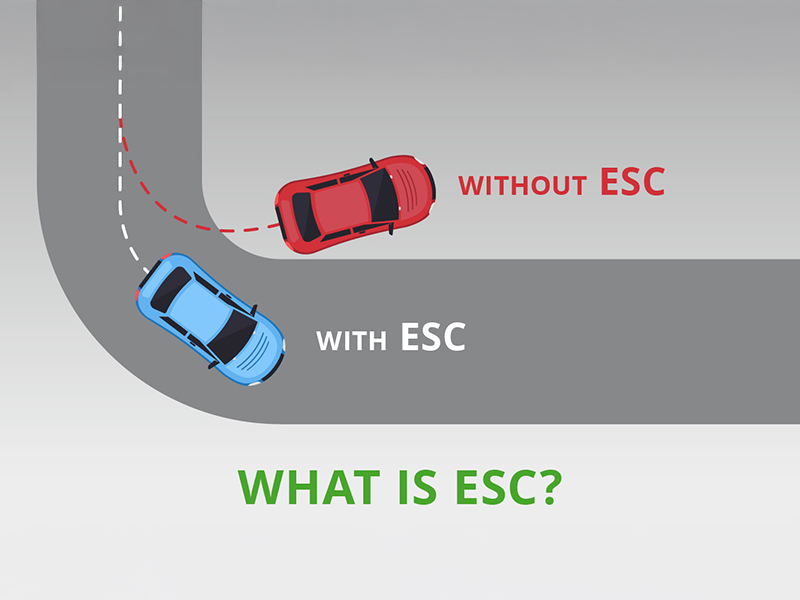
It has sensors installed that continuously check your car’s steering angle, wheel speed and direction. Suppose you turned the steering left but the car is going straight after slipping, then the system understands that something is wrong. The vehicle is then brought back towards your steering direction by ESC, applying brakes to various wheels. You may not notice this feature during your daily commute, but when a sudden skid occurs, you will understand how powerful it is.
2. How ESC Works to Maintain Vehicle Stability?
How ESC works is easy to understand. Step-by-step look at it:
- Monitoring: While driving, sensors constantly monitor your steering and wheels.
- Detection: The technology instantly recognises when the vehicle is deviating too much or slipping off course (understeer & oversteer).
- Action: Then, ESC applies the brakes to a specific wheel. For example, if the car is skidding to the left, the brakes are applied to the right-side wheel to restore balance.
- Result: The car returns to the track, and the driver regains control.
Imagine you’re turning onto a hilly road and your car starts to skid. Normally, the driver would panic, but ESC immediately brings the car back under control. That’s its power.
3. Key Benefits of Electronic Stability Control
The benefits of ESC are summarized in a single line – it takes control of the car before an accident occurs. But let’s look at the details:
- Skid Prevention: The biggest benefit is that it prevents the car from skidding. ESC is a lifesaver on rainy, snowy, or muddy roads.
- Better Turning: The car doesn’t lose its balance even on sharp turns.
- Driver Effortless: The driver doesn’t have to do anything extra; everything is automatic.
- Confidence: You gain confidence that if the car slips, the system will take control.
ESC is a feature that you may not notice in your daily drive, but a single second can make the difference between an accident and a safe journey.
| Extra Benefit | How it Helps the Driver |
| Works in the background | ESC is always active, even when the driver doesn’t notice it |
| Reduces accident chances | Prevents dangerous situations before they turn into crashes |
| Supports all drivers | Helpful for both beginners and experienced drivers |
| Complements other systems | Works along with ABS and traction control for overall safety |
4. ESC vs ABS: Understanding the Difference
People often confuse AC and ABS. They are two different technologies that complement each other.
| Point | ESC (Electronic Stability Control) | ABS (Anti-lock Braking System) |
| Purpose | Prevents the car from skidding and losing control | Prevents wheels from locking during sudden braking |
| Action | Applies brake force to individual wheels to keep the car in the intended direction | Maintains steering control by avoiding wheel lock |
| Works In | During sharp turns, slippery surfaces, or skid situations | During an emergency or hard braking |
| Main Benefit | Keeps the entire vehicle stable and on track | Ensures shorter stopping distance with control |
5. Why ESC is Essential for Road Safety
In a country like India, road conditions are unpredictable – sometimes sudden water, sometimes bad roads, sometimes speed breakers. Skidding is common in such situations. ESC helps the driver at such moments.
Imagine a new driver who, in panic, turns the steering too much. Normally, the car would go out of control, but ESC adjusts the brakes & brings it back on track. This is why ESC has been made mandatory in European countries and the US. Whether you drive in the city daily or on the highway, ESC is useful in all kinds of driving conditions. If you are planning to buy a car, do not forget to check ESC in the features list.
Conclusion:
Having ESC in your car means having an extra safety guard. You might not even notice its use on a daily basis, but when the road is slippery or the car suddenly skids, it will be this system that brings the car under control. One second is enough to avoid an accident, and ESC covers that very second. ABS and airbags are important in their own places, but ESC helps on a slightly different level. It keeps the car stable and prevents the driver from panicking.
If you’re looking at a new car, don’t ignore ESC while checking the features. Mileage and design all have their place, but safety comes first. An ESC is one such item that can literally save your life and the lives of your family.
FAQ’s
1. What does ESC do in a car?
Electronic Stability Control basically prevents the car from skidding. Suppose you’re taking a turn on a slippery road in the rain and your tires start to slide, the ESC brakes automatically apply, bringing the car under control. This reduces tension and makes for a safer drive.
2. How to fix the ESC error in a car?
If the ESC light comes on, first turn off the car and then start it again. Sometimes it’s just a minor glitch. If the light still stays on, there could be a problem with the sensor or wiring. So, it’s best to take it to a mechanic for a check; don’t try it yourself.
3. Can I drive with the ESC light on?
The ESC safety system will be turned off, but the car will still be able to drive. This means the car can easily slide on a slippery road or in a tight turn. This is fine for short distances, but the risk increases during long drives or tricky situations. It’s safest to have it checked by a mechanic as soon as possible.
4. Is it expensive to fix the ESC?
The cost mostly depends on the problem. If the sensor is simply dirty, simply cleaning it will be less. However, if the sensor or module is damaged or needs to be replaced, it could cost ₹5,000–10,000. Get it inspected first, then you’ll get an idea.
5. How to turn off the ESC?
The cost mostly depends on the problem. If the sensor is simply dirty, simply cleaning it will be less. However, if the sensor or module is damaged or needs to be replaced, it could cost ₹5,000–10,000. Get it inspected first, then you’ll get an idea.


