






Nissan has had a rough few years in India, and there is no point pretending otherwise. The brand that once turned heads with the Sunny and the Terrano gradually faded into the background as the market moved at a pace Nissan simply could not keep up with. The lineup shrank, the showrooms got quieter. While Maruti was launching fresh products every season, Hyundai was building loyalty at scale, and Tata was rewriting its own story, Nissan was largely watching from the sidelines. The Magnite gave the brand a brief moment of relevance, but one product does not rebuild an identity, and the Nissan Gravite is the next step in that attempt.
Which is why what Nissan is doing now deserves some attention. The company has been vocal about a product offensive in India, and the Nissan Gravite is the first real proof point of that ambition. Launched in February 2026, the Gravite is Nissan’s attempt to plant a flag in the affordable family MPV space, a segment that has been quietly growing as more Indian families outgrow their hatchbacks and start looking for something with three rows and a boot you can actually use.
The Nissan Gravite is aimed squarely at families who have been doing the math on a seven-seater and kept running into the problem that everything practical costs upwards of Rs. 8 lakh. It is for the buyer who drives a Swift or a Dzire and has outgrown it, the family whose weekend trips involve fitting four adults, two kids, and enough luggage for a getaway into one car. It is also for the first-time SUV buyer who wants more road presence than a hatchback without the EMI of an Ertiga or a Carens. The Gravite targets all three of those buyers at once.
Before you walk into a showroom or start shortlisting variants on your phone, there are things you should know about this car that the brochure will not tell you clearly. We have gone through the specs, the variant breakdown, the feature list, the mileage numbers, and the competition, so you do not have to piece it together from five different tabs. This blog covers the Nissan Gravite price range, what each variant actually gives you, how it stacks up against its rivals, and an honest verdict on who should buy it and who should probably look elsewhere.
Nissan Gravite Engine Specs and Mileage
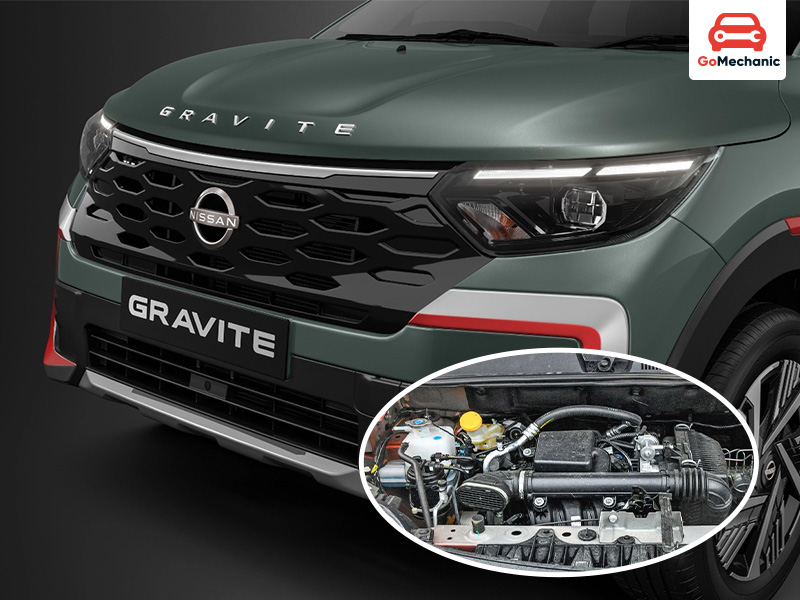
Quick answer: Gravite produces up to 72 PS, 96 Nm with a 1.0-litre NA petrol. ARAI claims 19.3 kmpl (MT) and 19.6 kmpl (AMT). Real-world city numbers will be closer to 10 – 12 kmpl.
The Nissan Gravite runs on a 1.0-litre three-cylinder naturally aspirated petrol engine shared with the Renault Triber, producing 72 PS and 96 Nm of torque. You can pair it with a five-speed manual or a five-speed AMT, and both options are available on the N-Connecta and Tekna variants. The engine is familiar territory for anyone who has driven the Triber, and that is mostly a good thing. It is smooth, quiet at low revs, and well-suited to city traffic where you are not asking it to work particularly hard. The AMT in particular makes sense if your daily commute involves a lot of stop-and-go.
On Nissan Gravite mileage, the ARAI-certified figures are 19.3 kmpl for the manual and 19.6 kmpl for the AMT. These are claimed numbers, and every Indian driver knows what to do with claimed numbers: take them as a ceiling, not a floor. CarWale’s real-world test returned about 10.67 kmpl in city conditions and 17.82 kmpl on the highway. For a daily commuter in Bengaluru or Delhi traffic, you are realistically looking at 11 to 13 kmpl on most days, which is perfectly acceptable for a seven-seater in this price bracket. On highway trips to Lonavala or longer weekend drives, the engine settles nicely and the fuel consumption improves meaningfully.
One thing worth flagging honestly is that the 1.0-litre NA engine does feel its limitations when the car is fully loaded. Three rows of adults, a boot full of bags, and a highway gradient will remind you that 72 PS is doing a lot of work. There is no turbo option currently, and Nissan has confirmed it is not coming for the Gravite. A dealer-installable CNG kit is in the works for the manual variants, which will change the running cost equation significantly for buyers who primarily drive within city limits. The Nissan Gravite mileage story on CNG should be considerably more attractive once that option is officially available.
Nissan Gravite Price and Variant Breakdown: Which One is the Better Choice?
Quick answer: You should skip the Visia because it has no infotainment system. The Acenta, on the other hand, at Rs. 6.59 lakh, is the minimum sensible buy. The N-Connecta is the best choice, and Tekna is worth it if you can stretch your budget.
The Nissan Gravite price range runs from Rs. 5.65 lakh for the base Visia to Rs. 8.94 lakh for the Tekna Launch Edition AMT. That is a wide spread for one model, and understanding what each variant actually adds over the one below it matters before you make a decision. The Visia at Rs. 5.65 lakh is bare bones to the point of being borderline impractical for everyday use. There is no infotainment system at all, no music system, no rear power windows, and no rear parking camera. The only real reason to consider it is if you need the absolute cheapest seven-seater registered in your name.
The Acenta at Rs. 6.59 lakh is where the car starts making sense. You get an 8-inch touchscreen with wireless Apple CarPlay and Android Auto, six airbags as standard, electronic stability control, and all the basic safety equipment. This is the variant for buyers who want an affordable seven-seater and can live without an AMT, rear power windows, and a parking camera. Step up to the N-Connecta at Rs. 7.20 lakh and those gaps start filling in: rear power windows, a rear parking camera with guidelines, LED tail lamps, roof rails, and the AMT option at Rs. 7.80 lakh. The N-Connecta is genuinely the sweet spot in the Nissan Gravite price lineup.
The Tekna at Rs. 7.91 lakh adds a seven-inch digital instrument cluster, push-button start, wireless charger, cruise control on the manual, auto-folding ORVMs, rain-sensing wipers, front parking sensors, a cooled glovebox, LED projector headlamps with DRLs, and leatherette upholstery. That Rs. 71,000 jump from the N-Connecta to the Tekna manual brings a meaningful upgrade in everyday convenience. The Tekna AMT at Rs. 8.49 lakh and the Launch Edition at Rs. 8.94 lakh add the JBL sound system, dual dashcam, ambient lighting, and cabin air purifier on a limited run of 1,001 units.
| Variant | Transmission | Ex-Showroom Price |
| Visia | 5-speed MT | Rs. 5.65 lakh |
| Acenta | 5-speed MT | Rs. 6.59 lakh |
| N-Connecta MT | 5-speed MT | Rs. 7.20 lakh |
| N-Connecta AMT | 5-speed AMT | Rs. 7.80 lakh |
| Tekna MT | 5-speed MT | Rs. 7.91 lakh |
| Tekna AMT | 5-speed AMT | Rs. 8.49 lakh |
| Tekna Launch Ed. AMT | 5-speed AMT | Rs. 8.94 lakh |
| Tekna CNG MT | 5-speed MT (dealer-fit) | Rs. 9.20 lakh |
Features and Technology
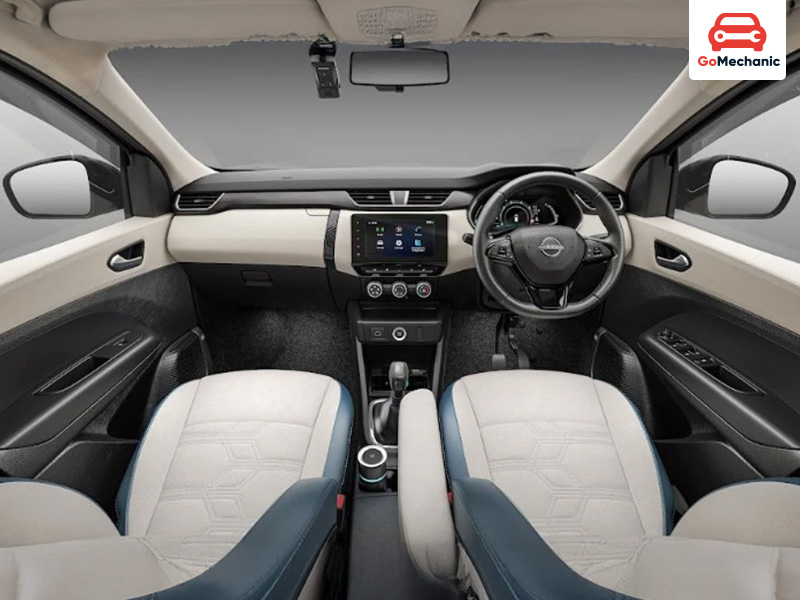
Quick answer: Safety kit is genuinely strong for the price. The cabin is practical and spacious, plus the Infotainment is solid. But no sunroof, no ADAS, no turbo, is a trade-off.
The Nissan Gravite’s strongest card at this price point is its safety specification. Six airbags are standard across all variants from Acenta onwards, which is genuinely impressive when most rivals at a similar price point offer two. Electronic Stability Control, Traction Control, Hill Start Assist, ABS with EBD, and TPMS are also standard. If safety is your primary concern and your budget is under Rs. 8 lakh, the Gravite immediately stands out from the crowd. Nissan offering this level of passive and active safety at this entry price is not marketing language. It is a real differentiator in this segment.
The 8-inch touchscreen available from the Acenta variant works well by all accounts, supporting wireless smartphone connectivity without the lag and drop issues that plague some budget infotainment systems. The Tekna gets a seven-inch digital instrument cluster to go with it, and the six-speaker audio system in the top trim is a noticeable upgrade over the base setup. There is a wireless charger in the Tekna, a cooled glovebox which is genuinely handy on Indian summer afternoons, and eight AC vents across the cabin for all three rows. For a Nissan Gravite priced under Rs. 9 lakh, the interior comfort story holds up well.
Where the Nissan Gravite does not tick every box is equally worth knowing. There is no sunroof, not even as an option on any variant, which will matter to a specific type of buyer. There are no ADAS features: no lane keep assist, no automatic emergency braking, no blind spot monitoring. The competition from Kia at higher price points offers all of this, but it is also significantly more expensive. Boot space in the standard seven-seat configuration is modest, but fold down or remove the third row and you get 625 litres, which is genuinely usable for a Coorg trip with full luggage. The flexible seating is the Gravite’s real party trick and it works well in practice.
How Does the Nissan Gravite Stack Up Against Its Rivals?
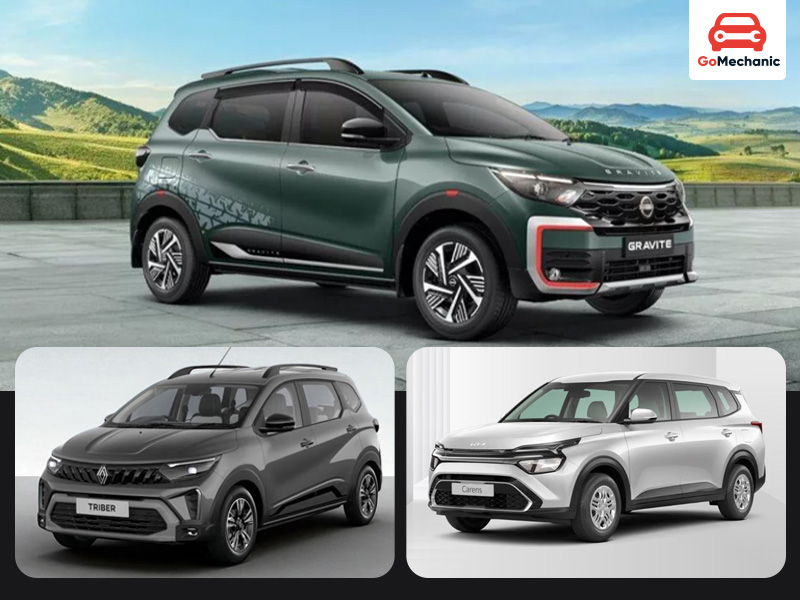
Quick answer: Gravite is Cheapest seven-seater available and beats the Triber on safety kit and styling. However, loses to the Ertiga on power and the Carens on features. Wins clearly on value-per-rupee.
The most direct rival to the Nissan Gravite is the Renault Triber, and this comparison matters because the Gravite is essentially a rebadged Triber on the CMF-A+ platform with Nissan-specific styling. The Gravite actually undercuts the Triber’s starting price of Rs. 5.76 lakh at launch and comes with a significantly more generous standard safety kit. Six airbags versus two is not a minor difference. If you are choosing between the two, the Gravite’s safety advantage at the same price is a compelling argument in its favour, and the Nissan dealer network, while not as wide as Renault’s, is expanding as part of the brand’s India push.
Against the Maruti Ertiga, the Gravite has a clear price advantage at the entry level. The Ertiga starts at around Rs. 8.69 lakh and runs a 1.5-litre petrol making 103 PS, which is noticeably more power than the Gravite’s 1.0-litre setup. The Ertiga also benefits from Maruti’s unmatched service network across India, which is a real ownership consideration for buyers in smaller cities and towns. But if you need a seven-seater under Rs. 8 lakh with strong safety equipment, the Ertiga simply cannot match the Nissan Gravite price proposition. You get meaningfully more car for meaningfully less money.
The Kia Carens is a different conversation altogether. It starts at Rs. 10.52 lakh, runs petrol and diesel engines, offers ADAS features in higher variants, and feels considerably more premium inside. For a buyer whose budget can stretch to Rs. 11 lakh or above, the Carens is a better all-round product. But for the buyer who is working within a Rs. 7 to Rs. 9 lakh envelope and needs three rows of practical seating, the Gravite and the Carens are not really competing for the same wallet. The Nissan Gravite wins the value-per-rupee argument in this segment without much contest.
| Parameter | Nissan Gravite | Renault Triber | Maruti Ertiga | Kia Carens |
| Starting Price | Rs. 5.65 L | Rs. 5.76 L | Rs. 8.69 L | Rs. 10.52 L |
| Engine | 1.0L NA Petrol | 1.0L NA Petrol | 1.5L Petrol | 1.5L Petrol/Diesel |
| Power | 72 PS | 72 PS | 103 PS | 115/115 PS |
| Claimed Mileage | 19.3–19.6 kmpl | 19.0–19.3 kmpl | 20.3 kmpl | 16–21.4 kmpl |
| Seating | 7 seats | 7 seats | 7 seats | 6/7 seats |
| Airbags (std) | 6 | 2 | 2 | 6 |
| Boot Space | 625 L (5-seat) | 625 L (5-seat) | 209 L | 216 L |
Should You Buy the Nissan Gravite? Here Is the Honest Verdict
Quick answer: Yes, if you need a practical seven-seater under Rs. 8.5 lakh and safety kit matters to you. No, if you want power, a sunroof, or ADAS features.
Buy the Nissan Gravite if you are an urban family that needs flexible seating for daily school runs and occasional highway trips, and you want the best safety specification available in this budget. Buy it if you have been stretching to afford a seven-seater and found the Ertiga just out of reach. Buy it if the N-Connecta or Tekna variant fits your budget, because those are where the car feels genuinely complete rather than compromised. The value proposition at this price range, particularly with six standard airbags across the range, is genuinely hard to argue against. Honestly, for what it costs, the Gravite offers more than most people expect from a Nissan right now.
Think carefully before buying the Nissan Gravite if your primary use case involves a lot of highway driving with a full load. The 1.0-litre NA engine will manage, but it will not inspire you. Consider looking elsewhere if a sunroof is a non-negotiable for you, because this car does not offer one at any price point. Also consider your city carefully: if you live somewhere that Nissan’s service network has not yet reached reliably, factor that into the ownership cost calculation. The brand is expanding its network as part of the India resurgence plan, but Maruti and Hyundai coverage it is not, at least not yet.
If you do bring home a Nissan Gravite, keeping it well maintained from the start is how you protect the investment. A well-serviced car holds its value better, performs more reliably, and costs you less in the long run. GoMechanic offers service packages for new Nissan vehicles with transparent pricing, trained technicians, and no bill surprises at pickup. You can book a service in a few minutes and get a clear quote before anything is touched. Because getting the right car at the right price is only half the job. The other half is making sure it stays in the condition it was on day one.
FAQ’s
Is Innova Crysta a safe car?
Short answer, yes… but with context. It feels solid, has a strong structure, and higher variants give you 7 airbags, VSC, ISOFIX, all the important stuff. The gap is there is no Bharat NCAP rating yet, so you are relying more on reputation and ASEAN data. Buy the right variant, and it becomes a much safer car in real life.
Which Toyota car has a 5-star safety rating?
Globally, a few Toyota models have scored 5 stars depending on the market, like the Innova Crysta in ASEAN NCAP and some Corolla variants internationally. In India specifically, there is no officially tested 5-star Toyota under Bharat NCAP yet. So you are mostly looking at international references, not India-specific confirmation.
What is the NCAP rating of Innova Crysta G?
There is no separate NCAP rating for the G variant, or any India-spec variant for that matter. The whole car hasn’t been tested under Bharat NCAP or Global NCAP yet. ASEAN NCAP gave it 5 stars, but that was a different market version, so you can’t directly apply it to the G trim you buy here.
What vehicle has a 5-star safety rating?
In India, cars like Tata Nexon, Punch, Mahindra XUV700, Scorpio N have scored 5 stars under Global or Bharat NCAP. These are properly tested, India-spec cars. That matters more than just brand reputation, because the data is clear and measurable, not assumed.
Which is the no. 1 safest SUV in India?
There isn’t one single “no.1” honestly, but XUV700, Tata Safari and Harrier are right at the top based on crash test results and safety features. They combine strong structure with ADAS and multiple airbags. So on paper and in real use, they cover both crash protection and accident prevention.
Is Innova Crysta a VIP car?
In India, yes, it kind of is. You see it with politicians, business owners, hotel fleets, airport pickups, that whole space. Not because it’s flashy, but because it’s reliable, comfortable and doesn’t give trouble on long runs. It’s more of a practical VIP car, not a show-off one.
Which car is more comfortable, Fortuner or Innova Crysta?
Innova Crysta, without overthinking it. It’s built for passengers, softer suspension, better second row, easier to sit in for long trips. Fortuner feels tougher and higher, but also stiffer and more driver-focused. If your priority is family comfort, Crysta just makes more sense.


 to 19.6 kmpl (AMT))