






In today’s time, when pollution and emission standards are getting stricter every day, car manufacturers have started using advanced technology in vehicles. One important part among them is the Catalytic Converter in a Car. The catalytic converter is installed in the exhaust of a car. When a car runs, harmful gases are released. It transforms such gases into less toxic ones. For instance, it produces water vapour, nitrogen & carbon dioxide from carbon monoxide and nitrogen oxides.
The catalytic converter, to put it simply, filters the air that exits the vehicle’s exhaust. Following the implementation of the BS6 rule in India, these have evolved to minimise vehicle pollution. If the catalytic converter is not in good condition, then the mileage, performance and emission of the vehicle are affected. In this blog, we will see in detail what a Catalytic Converter in a Car is, how it works, common problems, maintenance tips and what the replacement cost is in India.
What is a Catalytic Converter in a Car?
A Catalytic Converter in a Car is an exhaust emission control device that reduces harmful gases. This device is located inside the exhaust system, usually before the silencer. It has a ceramic honeycomb structure inside, in which precious metals like platinum, palladium and rhodium are used for coating. These metals work as catalysts whose role is to speed up chemical reactions.
A catalytic converter basically targets three types of pollutants:
- 1. Carbon Monoxide (CO) – which is formed when fuel is incompletely burned.
- 2. Hydrocarbons (HC) – Particles of unburned fuel.
- 3. Nitrogen Oxides (NOx) – which are formed when fuel is burned at high temperature.
These three gases are dangerous to both health & the environment. A catalytic converter changes them into less harmful gases. That is why it is necessary to have a catalytic converter in today’s modern cars and according to government norms, vehicles cannot legally run on the road without it.
Also read: What is IDV in Car Insurance: Everything You Need to Know
Catalytic Converter – Pros, Cons & Maintenance
| Pros | Cons | Maintenance Checklist |
| Reduces harmful emissions, eco-friendly | Fails the emission test easily | Use correct fuel & oil |
| Improves fuel efficiency, saves fuel | Poor mileage due to clogging | Avoid unsafe fuel additives |
| Smoother and quieter performance | Sluggish performance & less power | Fix engine misfires quickly |
| Prevent costly engine damage | Engine overheating due to a blockage | Watch the check engine light |
| Helps pass emission tests legally | May require costly replacement | Notice symptoms (smell, noise, low mileage) |
What Does a Catalytic Converter Do?
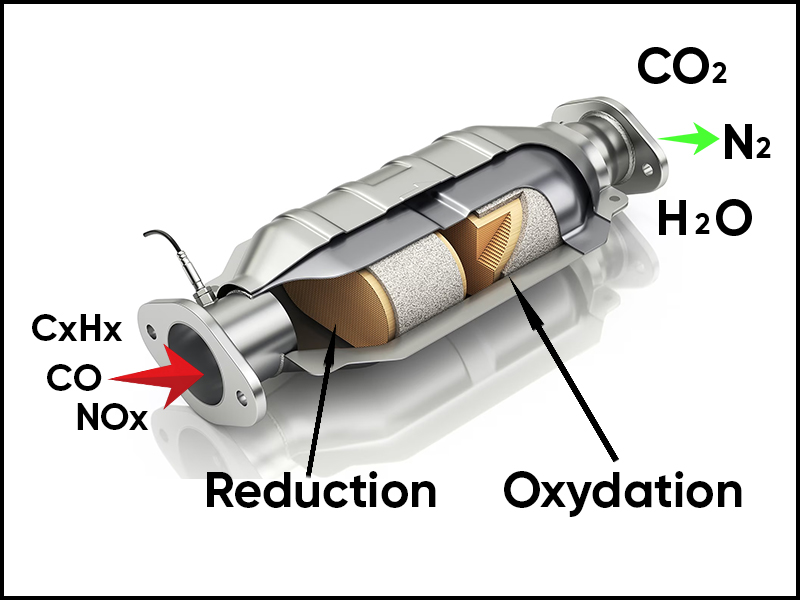
You must be wondering what the actual work of a Catalytic Converter in a car is. Its primary function is to control pollution, to put it simply. Exhaust gases, which are generated as engine fuel burns, contain numerous dangerous compounds. If released directly into the atmosphere, air pollution increases a lot.
A catalytic converter makes those harmful gases less harmful. For example –
- Converts Carbon Monoxide (CO) into Carbon Dioxide (CO2).
- Converts Hydrocarbons (HC) into Water Vapor (H2O) and Carbon Dioxide (CO2).
- Converts Nitrogen Oxides (NOx) into Nitrogen (N2) and Oxygen (O2).
All of this is made possible by a catalyst, which accelerates the processes without getting eaten. That is to say, the vehicles’ emissions would be extremely poisonous if there were no catalytic converter. However, the car can now fulfil BS standards and pollutant levels are significantly lower thanks to this gadget.
Also read: Importance Of Engine Diagnostics In Cars
How Does a Catalytic Converter Work?
The catalytic converter is an important part of the car’s exhaust system that reduces harmful gases. It works in such a way that the gases coming out of the engine go into its chamber and react with the catalyst metals. The CO and HC gases are oxidised and converted into CO2 and water, and the NOx gases are reduced to nitrogen and oxygen. All these processes happen at high temperatures, so the converter works best when the engine is hot.
Catalytic Converter Function Explained
The function of the Catalytic Converter in a Car is mainly based on three reactions:
- 1. Oxidation Reaction – Converts Carbon monoxide into carbon dioxide.
- 2. Oxidation of Hydrocarbons – Converts Hydrocarbons into water & carbon dioxide.
- 3. Reduction Reaction – Breaks down Nitrogen oxides into nitrogen & oxygen.
Let us take a simple example to understand this function. When you drive a car and the engine burns fuel, incomplete combustion also takes place in it. When combustion is incomplete, toxic gases are produced. Before they exit the exhaust, they are filtered and rendered innocuous by the catalytic converter.
Its design is also such that the flow is not disturbed while filtering the gases. The ceramic honeycomb or metallic substrate structure distributes the gases evenly and the catalyst coating makes the chemical reactions fast. In this way, the Catalytic Converter in a Car maintains the emission standards of the car, along with reducing pollution.
Also read: What is Car Detailing? The Art of Nurturing the Machine
Signs of a Bad Catalytic Converter
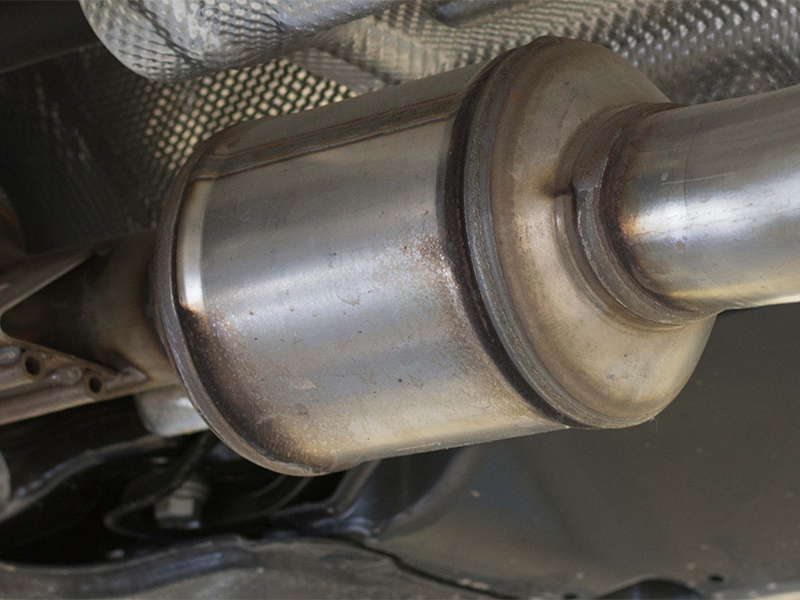
The performance of the vehicle & the environment are negatively impacted if the car’s catalytic converter is destroyed. Some common signs are:
- Engine Performance Down – Car becomes sluggish, pick-up decreases.
- Fuel Efficiency Low – Mileage drops noticeably.
- Check Engine Light On – OBD sensor detects catalytic converter issue.
- Rotten Egg Smell – Sulphur smell comes from the exhaust.
- Rattling Noise – The ceramic inside the converter starts shaking.
When such problems or signs start appearing in the car, it should be checked immediately. If the catalytic converter is blocked, the smoke of the engine cannot come out properly, and due to this the car can overheat and the engine can also get major damage.
That is why it is important that the catalytic converter is diagnosed and replaced on time. By doing so the car will run smoothly & pollution rules will also be followed properly.
Catalytic Converter Replacement Cost in India
In India, the cost of changing the catalytic converter depends on the car model. In normal cars, it ranges from around 15,000 to 60,000. If the car is luxury or imported, then its cost can be even higher, sometimes it can go above 1 lakh.
Replacement cost mainly depends on:
- Car brand and model
- OEM (Original Equipment Manufacturer) vs Aftermarket part
- Labour charges and service center location
For example, the cost of a catalytic converter in Maruti cars is around Rs. 15,000 – Rs. 25,000, while in Hyundai and Honda cars it can be up to Rs. 25,000 – Rs. 40,000. In luxury brands like BMW and Mercedes, the cost can easily be Rs. 80,000+.
That is why if the catalytic converter gets damaged, replacement should always be done from a trusted service center so that duplicate parts are not used.
Also read: What is a Turbo Engine? A Complete Guide
Catalytic Converter Maintenance Tips
You can increase the life of your Catalytic Converter in a Car if you follow some simple maintenance tips:
- Use the right fuel – Low-quality or adulterated fuel can clog the catalytic converter.
- Get the engine serviced on time – Regular servicing reduces incomplete combustion problems.
- Avoid Short Trips – The engine should be given time to warm up properly so that the catalytic converter can be activated.
- Check Exhaust Leaks – If there is a leak in the exhaust system, the converter will not function properly.
- Avoid Engine Misfire – Unburned fuel from a misfire can enter the catalytic converter and overheat and damage it.
If these small things are taken care of, the life of the catalytic converter can easily extend to more than 1,00,000 km.
Role of Catalytic Converter in Pollution Control
The biggest role of the Catalytic Converter in a Car is pollution control. In today’s time, when air pollution has become a global problem, it is very important to reduce the harmful gases coming out of vehicles. A catalytic converter does exactly this work.
Due to this device, the emissions coming out of the car come within international standards like BS6 and Euro 6. If there were no catalytic converter, the fumes coming out of the car would directly pollute the air.
Lakhs of vehicles ply on the roads in India every day, which is why the catalytic converter becomes very important. It reduces the harmful gases coming out of the exhaust of the vehicle, due to which the air remains a little cleaner and it does not have any bad effect on the health of the people. That is why it has been made compulsory to install a catalytic converter in every new car.
Conclusion:
In today’s blog, we have basically understood what a catalytic converter is in a car and why it is necessary. We got an idea of its work, problems, cost of replacement, and some maintenance. This part is not big in size, but the car depends on it to a great extent, because if it gets damaged, mileage goes down, pickup is also affected and more smoke is emitted.
So it is a simple thing, when you drive the car, you should keep checking the condition of the catalytic converter and get it serviced on time. If the fuel is good and the vehicle is driven comfortably, its life expectancy increases easily. In the end, this small thing is useful for the vehicle and also keeps the environment safe.
FAQ’s
1. Can a car run without a catalytic converter?
There will be more air pollution even if the car functions without a catalytic converter. Additionally, the sound of the engine gets a bit louder. A little extra fuel may be used and there can be legal problems as it becomes difficult to clear the emission test.
2. What is the purpose of a catalytic converter in a car?
Its main job is to clean the car’s exhaust. It converts dirty gases into less harmful gases. This makes the air less polluted and the car follows environmental rules, this part makes the car a little eco-friendly.
3. How much will it cost to replace a catalytic converter?
The price totally depends on the car. Normal cars cost up to 20-50 thousand. If the car is big or imported, it can cost more than a lakh. If you get a part from the local market, it is cheaper, but the original part is always expensive.
4. Why do thieves steal catalytic converters?
Because it contains valuable metals like palladium & platinum, thieves steal it. These metals are easily sold and their value is high. It is not difficult to remove the converter, it is a matter of two minutes, that is why if the car is parked, they quickly leave.
5. What car is most likely to have its catalytic converter stolen?
Mostly SUVs and truck converters are stolen more because their height makes it easy to sneak underneath. Toyota Prius, Innova, Fortuner and some hybrid cars are more targeted. Hybrid cars also have more metals, so their demand for thieves becomes even higher.


