






Engine placement might not appear something important but its layout plays a huge role in a car’s design. The placement mainly determines if the car will be rear or front-wheel drive. Let’s take a look at these two placements, what they are and how they affect a car and its dynamics.
Transverse Engine Placement
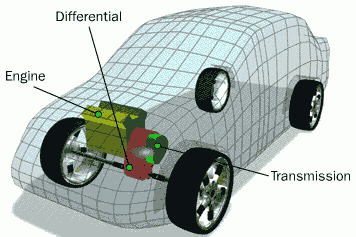
This engine placement can be described as the engine mounted in such a way that it is perpendicular to the direction of cars travel. The cylinders go from right to left while the travel is a straight line which makes it perpendicular to the direction of travel.
Transverse engines are usually used for front-wheel-drive cars. It connects directly to a transaxle which then is connected to the half shafts and CV joints completing the transmission by linking with the wheels. More on transaxles here.
Advantage
- This engine placement allows for more freedom as the automakers can keep the car length unchanged but still get more space on the inside. This allows for more boot space or even more passenger space.
- Transverse engine placement also puts most of the car’s weight on the front tires. This helps with improving the traction of tyres in a front-wheel-drive but it is likely to increase understeer.
- Due to being front-wheel driven, there are fewer drivetrain components which allow for better weight management making the car lighter. This also reduces manufacturing costs and this makes the car cheaper.
- Even the power transmission losses are lower in a vehicle with a transversely mounted engine.
Disadvantage
- The engine placement causes torque steer. As the engine is placed a bit towards the side, one of the driveshafts will be bigger than the other. This longer driveshaft will have lower torsional stiffness which means it will steer towards the side with the longer driveshaft. This problem is solved by using a hollow shaft and a solid shaft causing both shafts to have the same stiffness.
- The engine size is restricted heavily which in turn restricts the power output you get from the car. Too big of an engine simply won’t fit.
Onwards to longitudinal engine placement, the choice for high-performance cars.
Longitudinal Engine Placement
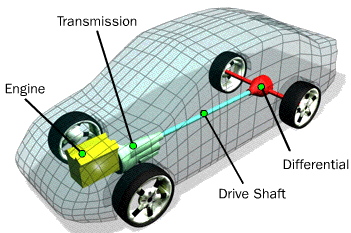
Mostly used in front-engine rear-wheel drive, the longitudinal engine has its cylinders in a front to back orientation making them parallel to the direction of the travel. These are usually used in high-performance cars due to multiple advantages they provide over transverse engines, which are mentioned below.
Download The GoMechanic App Now!
Advantages
- This one is applicable for front-engine rear-wheel drive and rear-engine rear-wheel drive. The formerly stated configuration allows for really good front to rear weight distribution due to engine in the front and differential in the back. This is better for cars that need to make tight turns and is thus better than what transverse offers.
- They offer more power as the engine can be quite big and thus have more displacement.
Disadvantages
- Longitudinal engines take up more space thus reducing cabin space. Increasing cars length to counter this is not optimal as these engines are usually made for powerful cars which don’t need extra weight.
- They are less efficient than transverse because of the driven wheel being in the rear. This makes the rotational energy change direction which wastes energy.
- Due to more parts involved in the drivetrain, it makes the car heavy and costlier to manufacture.
Which Is Better?
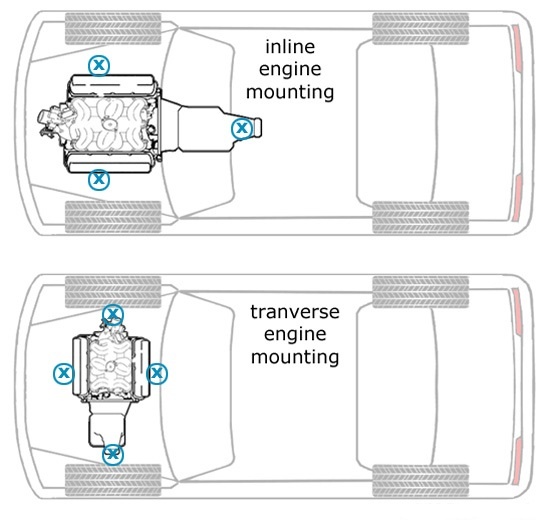
This is another one of those ‘both are good in their own ways’ kind of answer. Transverse placement is certainly good for low to mid-range cars as they are more efficient and cheaper to make and don’t take up a lot of space. Longitudinal on the other hand offers better power due to having bigger engines and good handling because of their front to rear weight distribution ratio.
Also, Read 8 Reasons Why Nissan Magnite Can Take On The Rivals
They both certainly work well enough in what they excel and as such are still used and are still being improved upon.
Informative: VVT (Variable Valve Timing) and its Features Explained
FAQs:
1. What is the difference between a transverse and longitudinal engine?
It comes down to direction. A transverse engine lies across the car, like a plank stretched sideways. A longitudinal engine lies lengthwise, running nose to tail. That single choice shapes the car itself. Sideways keeps the cabin roomy and cheap to build. Lengthwise holds power steady, ideal for big torque and rear-wheel drive. One is built for economy, the other for balance and strength.
2. What is a transverse car?
Think of your everyday hatchback — Swift, i20, Baleno. The engine is tucked sideways, sending power straight to the front wheels. That’s a transverse car. The design is compact, space-efficient, and built for city roads where agility matters more than brute force.
3. What is better, transverse or longitudinal?
There is no universal better. A transverse setup makes sense when you want affordability and space — the logic of most mass-market cars. A longitudinal setup wins when weight distribution and high torque matter — the logic of performance sedans and SUVs. Better is not a crown, it is a fit to purpose.
4. Are transverse engines better?
Better for the majority, yes. They cut costs, save space, and are easy to service. That is why most small and mid-size cars on Indian roads use them. But if you step into luxury or racing, the game shifts. Longitudinal layouts take over because stability under strain matters more than saving a few inches of room.
5. What is the main difference between transverse and longitudinal?
It is placement, nothing more and nothing less. Sideways means transverse, lengthwise means longitudinal. From that line flows everything: drivetrain, space, handling, even the type of buyer who chooses the car.



Your post is a breath of fresh air in a sea of generic content on this topic. It offers a unique perspective.