






The legacy of Aston Martin commenced in 1913, built on a simple idea – To make fast, beautiful cars that catch the attention of everyone. The founders, Lionel Martin and Robert Bamford, were not chasing mass production, they were chasing precision, racing success, and a kind of British elegance that didn’t need to show off. However, success didn’t come easily. The early years were tough, especially because of war, financial struggles, and limited resources, but the obsession never faded. This pursuit still shapes the idea of the fastest Aston Martin. The breakthrough came via motorsport. Victories in hill climbs, endurance races, and later Le Mans turned Aston Martin from a passionate idea into a global name. Cars like the DB series carried racing abilities into public roads, blending performance with restraint. From there on, Aston Martin became a symbol of controlled power, not brute force. Fast, yes, but always measured. That legacy is why the question of the Fastest Aston Martin matters today. Speed has always been part of the brand’s identity, even when comfort, design, and balance took equal priority. As engineering evolved, so did the numbers. Today, when people search for the fastest Aston Martin cars in the world, they really want to know how far that original idea has been pushed. And that is exactly what we are going to tell you in this blog.
Top 3 Aston Martin Cars in the World
1. Aston Martin Valkyrie
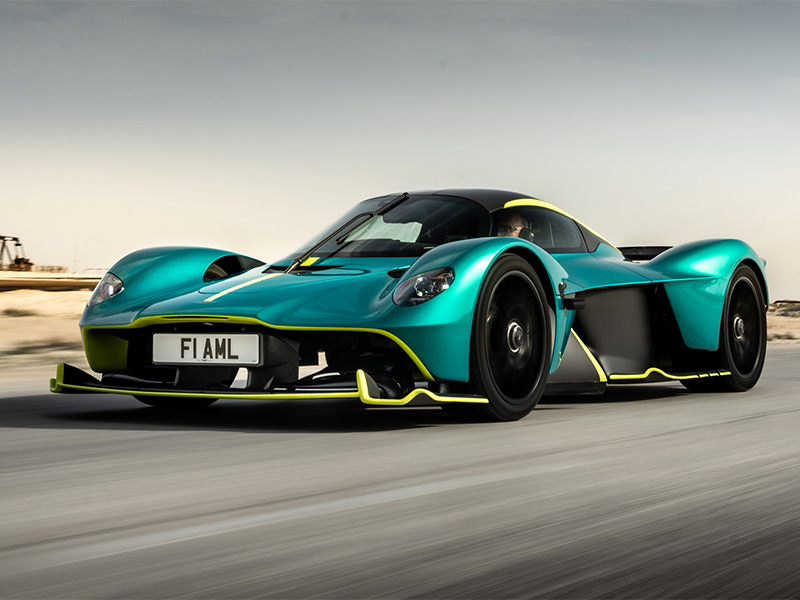
The Aston Martin Valkyrie is not a supercar in the traditional sense. It’s a combination of everything it learned from racing and asking how little can be left between a road car and a Formula One machine. From the outside, the intent is obvious – To merge a race car with a road car. The body is sculpted almost entirely by airflow, with deep channels running through the car rather than around it. There is barely any visual mass, just carbon fibre shaped to generate down force, stability, and speed. Now, if you get beneath that extreme exterior, you’ll find a 6.5-litre naturally aspirated V12 developed by Cosworth, paired with a hybrid electric system, producing a combined 1,055 PS. A 7-speed sequential automated manual gearbox sends the power to the rear wheels, keeping weight low and response sharp. Once you step inside, the Valkyrie continues to be unconventional. The cabin is minimal, tight, and purpose-driven, with fixed carbon seats, exposed materials, and a steering wheel-style control unit replacing a traditional dashboard. It can be easily determined that comfort is a secondary goal and performance is primary, with a focus on figures – a 0–100 km/h time of around 2.5 seconds and a top speed of approximately 345 km/h. The Valkyrie exists to redefine what the fastest Aston Martin can be.
Specs at Glance:
| Specification | Details |
| Engine | 6.5-litre naturally aspirated V12 |
| Hybrid System | Electric motor (hybrid assist) |
| Max Power | 1,055 PS (combined) |
| Max Torque | ~900 Nm (combined) |
| 0 – 100 km/h | ~2.5 seconds |
| Top Speed | ~345 km/h (electronically limited) |
2. Aston Martin Valkyrie Spider
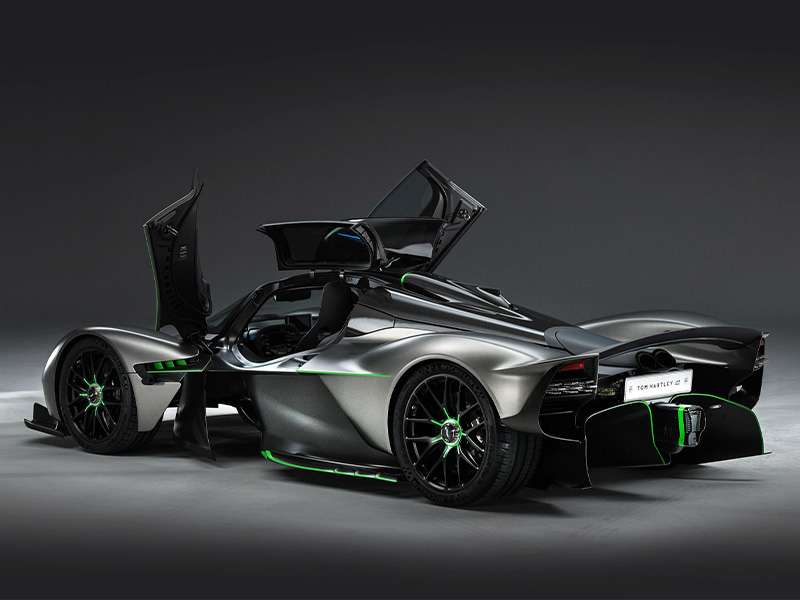
The Spider’s main motive was to merge the car and the person driving it. From the outside, the carbon-fibre body stays intact. However, there is no permanent roof to interrupt that form, just the structure doing its job at speed. Underneath, nothing changes mechanically. Step inside, and the Spider feels even more stripped back than the coupe. Fixed carbon seats, exposed surfaces, and a compact steering-mounted display replace anything that feels familiar. There is no attempt to isolate you from heat, noise, or movement, and the performance stays uncompromised, with a 0 -100 km/h time of around 2.5 seconds and a top speed close to 345 km/h.
Specs at Glance:
| Specification | Details |
| Engine | 6.5-litre naturally aspirated V12 |
| Hybrid System | Electric motor (hybrid assist) |
| Max Power | 1,055 PS (combined) |
| Max Torque | ~900 Nm (combined) |
| 0–100 km/h | ~2.5 seconds |
| Top Speed | ~345 km/h |
3. Aston Martin One-77
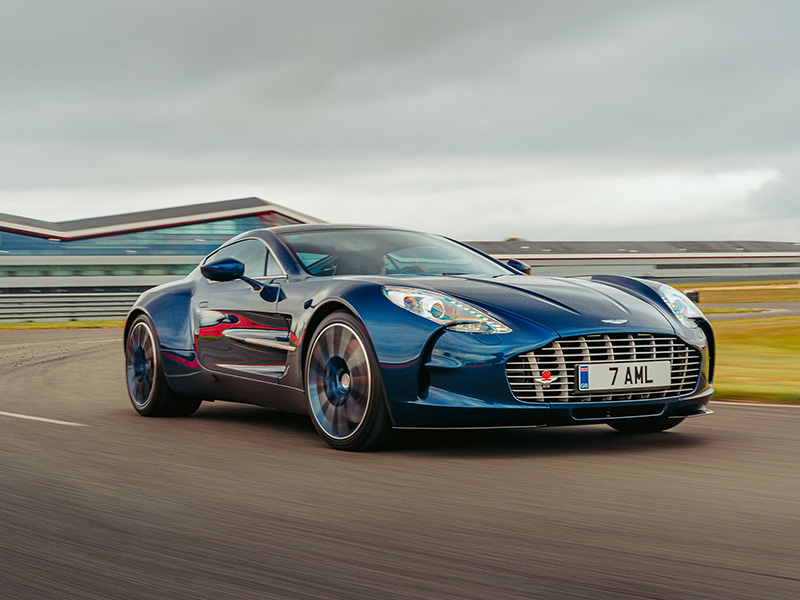
The Aston Martin One-77 arrived at a time when speed was still about displacement, not software or algorithms deciding outcomes. This was not a car built to chase lap records or rewrite aerodynamics. It was Aston Martin deciding to see how far it could push a road car using the tools it understood best. From the outside, the One-77 looks muscular with the long bonnet, wide stance, and flowing aluminium body panels carry weight, the good kind, because everything is shaped around what sits beneath. A 7.3-litre naturally aspirated V12 producing 760 PS, sending power to the rear wheels through a 6-speed automated manual gearbox. For its time, the numbers were serious. Around 3.7 seconds to 100 km/h and a tested top speed close to 354 km/h. It is still a performance car, but one that expects to be driven on real roads. The One-77 does not try to feel modern by today’s standards. But it stands as a peak moment when Aston Martin pushed engineering as fas as possible, and that is why it still holds its place in any conversation about the fastest Aston Martin ever built.
Specs at Glance:
| Specification | Details |
| Engine | 7.3-litre naturally aspirated V12 |
| Max Power | 760 PS |
| Max Torque | 750 Nm |
| 0–100 km/h | ~3.7 seconds |
| Top Speed | ~354 km/h |
Comparison of Fastest Aston Martin Cars in the World at a Glance
| Model | Engine | Power Output | 0–100 km/h | Top Speed |
| Aston Martin Valkyrie | 6.5L NA V12 + hybrid | 1,055 PS | ~2.5 sec | ~345 km/h |
| Aston Martin Valkyrie Spider | 6.5L NA V12 + hybrid | 1,055 PS | ~2.5 sec | ~345 km/h |
| Aston Martin One-77 | 7.3L NA V12 | 760 PS | ~3.7 sec | ~354 km/h |
Conclusion
Aston Martin’s goal wasn’t always just about speed, it has always been a result of design, balance, and restraint. From the balance of the One-77 to the extreme engineering of the Valkyrie, the brand approaches performance differently from most. The fastest Aston Martin is not just defined by numbers. It is defined by intent. Some models exist to push boundaries. Others exist to make speed usable, repeatable, and meaningful on real roads. That is why the question of the fastest Aston Martin matters. Not because of how fast it goes once, but because of how that speed is delivered, controlled, and experienced. And that philosophy is what continues to set Aston Martin apart.
FAQ’s
1. What’s the rarest Aston Martin?
In terms of pure rarity, the Aston Martin DBR1/1 from the 1950s stands alone. It was one of only five DBR1s ever built. And also went on to win Le Mans in 1959. However, among modern, road-legal Aston Martins, the One-77 remains the rarest, with just 77 units produced worldwide.
2. Is the Valkyrie street legal?
Yes, the Valkyrie is street legal in select markets. It meets road regulations, but only just. Its low ride height, heat output, and focus mean it feels far more at home in controlled conditions.
3. Is Aston Martin faster than Ferrari?
Yes, but in certain cases, cars like the Valkyrie can rival Ferrari hypercars in straight-line performance. Ferrari, however, generally holds the edge in track consistency and performance.
4. Which is the fastest Aston Martin car?
The Aston Martin Valkyrie is the fastest Aston Martin ever built with a hybrid-assisted V12 and extreme aerodynamics, it represents the peak of the brand’s performance capability.


