






Tyres are the most neglected part of car maintenance in India, and that is not an opinion, it is just what the numbers show. People will religiously track their engine oil change interval, fuss over the AC gas top-up every summer, and schedule their full body wash before a road trip. Meanwhile the four patches of rubber that are actually keeping the car on the road, each one roughly the size of a human palm, get checked maybe once a year if they are lucky. Ask the average car owner their tyre size or the last date they checked tyre pressure and you will mostly get a blank stare. It is the kind of thing people intend to get around to and never do.
This problem hits compact SUV owners harder than most, and getting the Hyundai Venue tyre size right, then keeping it at the right pressure, is more consequential than most owners realise. The Venue sits higher off the ground, weighs more than a hatchback, and gets used on road. Add highway driving at speeds where tyre integrity genuinely matters, and the margin for error on worn or under-inflated tyres decreases significantly.
The Hyundai Venue is one of the best-selling compact SUVs in India, and a large portion of its owners have never once checked what the correct Hyundai Venue tyre size is for their specific variant. That is where things go wrong at the tyre shop. You walk in, the guy behind the counter asks what size you need, you shrug and say “check the car”, and you come out with whatever he had in stock that day, at whatever price he decided to charge. It does not have to work that way.
Most Venue owners who have been through a bad tyre shop experience will tell you the same thing: they felt like they had no ground to stand on. The shop said one thing, the price felt off, but they had no way to push back because they did not know the numbers. This blog is the fix for that and by the time you finish reading, you will know your correct tyre size, what the pressure should be, which brands are worth the money, what a fair replacement quote looks like, and exactly when your current tyres are actually due for a change
How to Read Your Hyundai Venue Tyre Size Number?
Quick Answer – The number on your tyre sidewall like 195/65 R15 tells you width, profile height, and wheel diameter in that order. Getting this wrong when replacing tyres affects your speedometer, handling, and ABS calibration. Always match the original spec exactly.
That string of numbers on your tyre sidewall is not as cryptic as it looks. Take 195/65 R15, which is what the 1.2L Venue runs on. The 195 is the tyre width in millimetres across the tread. The 65 is the aspect ratio, meaning the sidewall height is 65 percent of that width, so roughly 127mm of rubber between your rim and the road. R just means radial, which every modern car tyre is. The 15 at the end is the rim diameter in inches. Read it once and you will never forget it.
Tyre shops will fit whatever is close if you do not tell them exactly what you need, and some will do it knowingly because it clears their stock. A slightly wrong size changes the rolling circumference of the wheel, which sounds minor until you realise your speedometer is now reading off, your odometer is logging slightly wrong distances, and your ABS is making decisions based on wheel speed data that no longer matches reality. That last part is the one that actually matters on a wet road at 80 kmph. Check the sticker on your driver’s door jamb, find the Hyundai Venue tyre size printed there, and read it out to the shop yourself before they touch the car.
After the size code there is usually something like 91H or 95V, and those matter too. The number is the load index, so 91 means each tyre can handle up to 615 kg. The letter is the speed rating, with H meaning safe for sustained highway speeds up to 210 kmph. When replacing, match or exceed both figures. Going lower on either is not a cost-saving move, it is a safety compromise, and a good tyre shop should flag this without you even having to ask.
Variant-wise Hyundai Venue Tyre Size Breakdown
Quick Answer – The Venue uses two tyre sizes: 195/65 R15 on all 1.2L petrol variants, and 215/60 R16 on turbo petrol and diesel variants. Check your variant before going to a tyre shop. Fitting the wrong size is more common than it should be and entirely avoidable.
| Variant Group | Engine | Tyre Size | Wheel Size |
| E, S, S(O), S(O)+ | 1.2L petrol | 195/65 R15 | 15-inch |
| S(O) 1.0T MT, Executive 1.0T | 1.0L turbo petrol | 215/60 R16 | 16-inch |
| SX, SX(O) 1.0T MT/DCT | 1.0L turbo petrol | 215/60 R16 | 16-inch |
| S(O) 1.5 diesel, SX 1.5 diesel | 1.5L diesel | 215/60 R16 | 16-inch |
| SX(O) 1.5 diesel, N Line | 1.5L diesel / 1.0T | 215/60 R16 | 16-inch |
Hyundai Venue Tyre Pressure: What It Should Be and Why It Matters
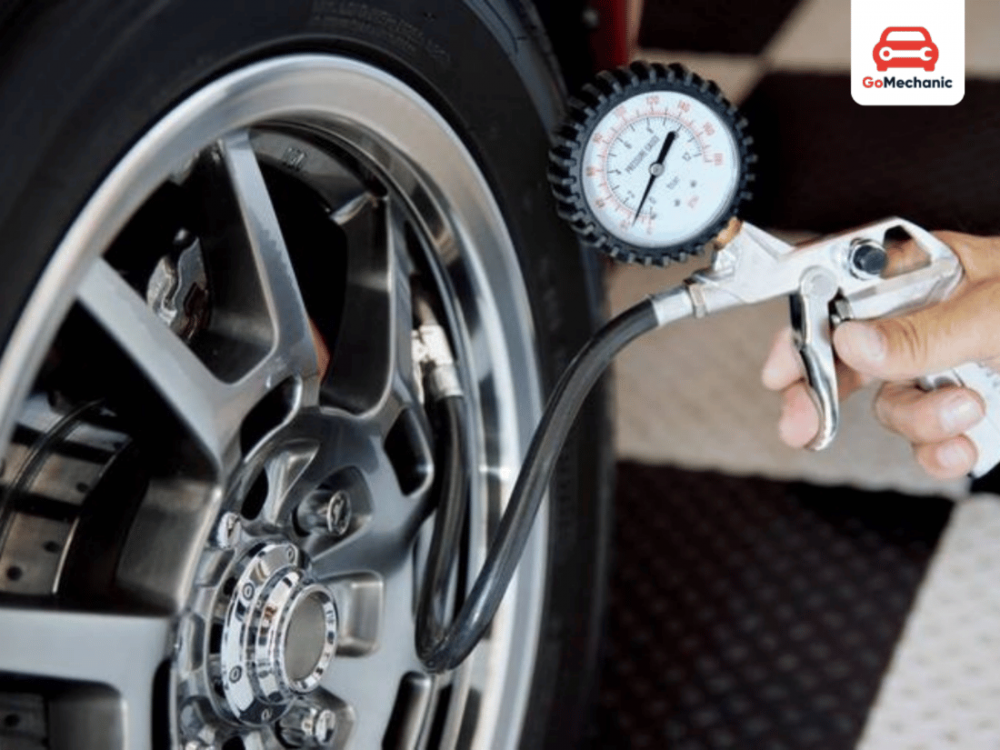
Quick Answer – The correct Hyundai Venue tyre pressure is 33 PSI for all four tyres under normal load. Under full load, increase to 36 to 38 PSI. These figures apply to cold tyres, checked before you have driven the car. Check the driver’s door jamb sticker for confirmation.
Tyre pressure is one of those things where the cost of getting it right is zero and the cost of getting it wrong is real. The recommended Hyundai Venue tyre pressure is 33 PSI cold for normal driving conditions, meaning up to two or three occupants with light luggage. When the car is fully loaded, five people and bags for a weekend trip, Hyundai recommends increasing to 36 to 38 PSI to account for the additional weight bearing down on each tyre. The BAR equivalent is 2.3 BAR at normal load and 2.5 to 2.6 BAR at full load, for owners whose gauges show that unit.
Hyundai Venue tyre pressure reference:
| Load Condition | Front (PSI) | Rear (PSI) | Front (BAR) | Rear (BAR) |
| Normal load (up to 3 occupants) | 33 PSI | 33 PSI | 2.3 BAR | 2.3 BAR |
| Full load (5 occupants + luggage) | 36–38 PSI | 36–38 PSI | 2.5–2.6 BAR | 2.5–2.6 BAR |
Check cold tyre pressure, before the car has been driven. Hot tyre pressure reads 2–3 PSI higher and will give a false reading.
Most people only notice their tyres are low when the car starts feeling different, and by that point the damage is already happening. Under-inflated rubber flexes more through every rotation than it was built to handle, which generates heat inside the tyre casing. In Indian summers on highway stretches that heat builds up fast, and a tyre that is already soft and then hits a pothole at speed is in real blowout territory. The fuel economy hit is quieter but just as consistent. Running 5 PSI low means the engine is working against extra rolling resistance for every single kilometre, and that adds up on a monthly petrol bill whether you notice it or not.
Over-inflation does different damage and gets far less attention. A tyre pumped too hard rides on a smaller strip down the middle of the tread instead of the full contact patch, so the centre wears out while the edges still look fine. Wet grip drops because there is less rubber actually touching the road. The other thing most owners do not know is that over-inflation makes the tyre less able to absorb sharp impacts, which matters on Indian roads where you cannot always see what is coming. Check pressure cold once a month, carry a basic gauge in the glovebox, and add a few PSI before a long loaded trip. That is genuinely all it takes
Hyundai Venue Tyre Price: What to Budget for a Replacement
Quick Answer – Budget ₹5,000 to ₹7,500 per tyre for mid-range brands on the 195/65 R15 size. The 215/60 R16 runs slightly higher. Premium brands like Michelin and Bridgestone cost ₹8,000 to ₹12,000 per tyre. Add ₹300 to ₹500 per tyre for fitting and balancing, and budget for alignment separately.
Brand-wise tyre price range (per tyre, India market):
| Brand | 195/65 R15 (approx) | 215/60 R16 (approx) | Segment |
| CEAT SecuraDrive | ₹5,500 – ₹6,500 | ₹6,500 – ₹7,500 | Mid-range |
| Apollo Alnac 4G | ₹5,300 – ₹6,500 | ₹6,200 – ₹7,500 | Mid-range |
| MRF ZV2K / Wanderer | ₹6,000 – ₹7,500 | ₹7,000 – ₹8,500 | Mid-range |
| Goodyear Assurance | ₹6,500 – ₹8,000 | ₹7,500 – ₹9,000 | Mid to premium |
| Bridgestone Turanza | ₹8,000 – ₹10,000 | ₹9,000 – ₹11,000 | Premium |
| Michelin Energy XM2+ | ₹9,000 – ₹12,000 | ₹10,000 – ₹12,500 | Premium |
Prices are approximate and vary by city and retailer. Always get quotes from at least two shops before confirming.
Conclusion
Knowing your correct Hyundai Venue tyre size before you walk into a tyre shop is genuinely half the battle. For the 1.2L petrol Venue it is 195/65 R15. For anything with a turbo petrol or diesel engine it is 215/60 R16. Write whichever applies to you on your phone right now, because the moment you can say it out loud at the counter the entire dynamic of that conversation changes. You stop being someone to be quoted at and start being someone who knows what they came for.
Pressure is the low-effort, high-return habit most Venue owners are skipping. Thirty-three PSI cold, once a month, takes about four minutes with a basic gauge from any auto parts shop. That alone will noticeably improve the fuel average and stop the tyres from wearing unevenly. Bump it to 36 to 38 PSI when the car is genuinely loaded for a road trip, then drop it back after. Not complicated, just never done.
On brand, MRF and CEAT are the honest answer for most people. If you are covering serious kilometres every month or regularly doing highway runs, Michelin or Bridgestone will outlast the cheaper options by enough to justify the price difference. Either way, do not let a tyre shop skip the wheel alignment after a new set. GoMechanic does the full job properly, fitting, balancing, and alignment, with the price told to you upfront rather than revealed at billing.
FAQ’s
Should tyre pressure be 32 or 34?
For the Venue, sitting close to the recommended figure matters more than chasing exact numbers. Slightly above or below won’t break anything immediately, but over time it starts affecting wear and fuel use. That is why sticking to the recommended pressure is the safer habit, not guessing between two numbers.
Is 35 or 45 psi better for a tyre?
Neither blindly, because tyre pressure is not something you pick randomly. Too low increases wear and heat, too high reduces grip and comfort. That is why following the recommended range matters more than chasing a higher number thinking it is better.
How often should you check tyre pressure?
Ideally once a month, and definitely before a long trip. It takes just a few minutes, but most people skip it until something feels wrong. By then, the tyre has already taken extra stress for days or weeks.
Does wrong tyre size affect driving?
Yes, more than it looks on the surface. Even a slightly different size changes how the car reads speed and distance, and how systems like ABS behave. It may feel fine at first, but over time the difference starts showing up.
What are the best tyres for a Hyundai Venue?
Again, it comes down to usage more than brand names alone. For everyday driving, mid-range tyres do the job just fine without overspending. For longer drives and better durability, premium tyres are worth considering, but only if your usage actually justifies it.
When should you replace your tyres?
When the tread starts wearing out or the tyre shows signs of ageing like cracks. Waiting too long just increases the risk, especially on highways. It is one of those things better done slightly early than slightly late.


 and 215/60 R16 (higher variants), and its price ranges from ₹3,500 - ₹10,000+ per tyre, depending on brand)