






Electric SUVs in India are no longer just showpieces or “future tech” experiments, they’re becoming serious everyday options for buyers who want the size and presence of a proper SUV without the fuel bills. Right now, the two names making the most noise are the Tata Harrier EV vs Mahindra XEV 9e. Both are priced in the ₹21–30 lakh bracket, both come with big batteries and premium cabins, and both carry the stance of a full-size SUV rather than a compact crossover.
That’s why the debate has become simple but important: Harrier EV vs XEV 9e, which one actually makes more sense for Indian buyers? To answer that, we need to look beyond just the spec sheet. How do they compare on design and road presence, how much space and ground clearance do you get, what kind of interiors and features are on offer, and how do they stack up on range, charging, safety, and price? Let’s break it down.
You can check Sedan vs SUV: A Complete Guide to Choosing the Right Car to understand about these car’s body type in detail.
Exterior and Road Presence
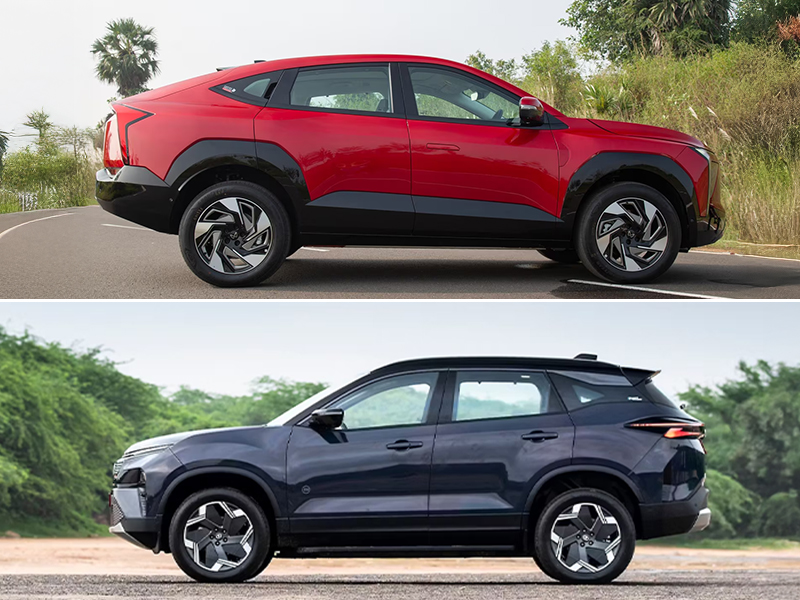
When you compare Tata Harrier EV vs Mahindra XEV 9e on design, the Tata Harrier.ev keeps the muscular stance of the diesel Harrier but adds EV-specific touches like the closed grille, new lighting signatures, and sharper bumpers. It’s wide, squat, and has that SUV road presence Tata has built a reputation for.
The Mahindra XEV 9e takes a slightly different route. It feels more futuristic with its coupe-ish silhouette, layered LED DRLs, and that signature Mahindra EV face. It looks more like a new-age premium EV than a converted ICE SUV.
Verdict: Harrier.ev will appeal if you like traditional SUV muscle. XEV 9e is for those who want a sharper, modern design.
Dimensions and Ground Clearance
| Specification | Tata Harrier.ev | Mahindra XEV 9e |
| Length | ~4600 mm | ~4790 mm |
| Width | ~1890 mm | ~1890 mm |
| Height | ~1706 mm | ~1690 mm |
| Wheelbase | ~2741 mm | ~2775 mm |
| Ground Clearance | ~200 mm | ~190–200 mm |
On paper, the Tata Harrier EV vs Mahindra XEV 9e dimensions show the Mahindra is slightly longer and has a bigger wheelbase, which translates to more cabin space, especially in the second row. The Harrier.ev holds its own with a high stance and competitive ground clearance, which is critical for Indian roads.
You can read Car Coating | Teflon Vs Ceramic | Explained to keep your car’s exterior protected.
Interior and Comfort
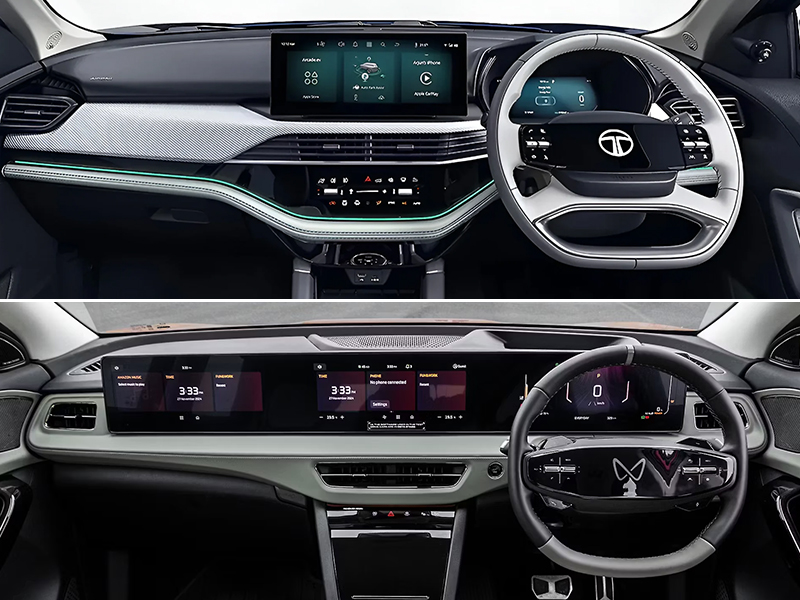
Inside, both SUVs step away from their ICE roots and embrace a more premium EV feel.
Harrier.ev gets a 14.53-inch QLED infotainment screen, a 10.25-inch driver’s display, a clean layered dashboard, ambient lighting, ventilated seats, and a panoramic sunroof. It feels premium yet familiar to Tata buyers.
XEV 9e pushes harder into the future. Top variants get triple screens on the dash, a minimalist centre console, Harman Kardon audio, and a more lounge-like feel in the cabin.
Verdict: Harrier.ev feels like an upgrade on a familiar platform. XEV 9e feels like a new benchmark in design. Pick depending on how futuristic you want your daily drive to feel.
Battery, Range, and Performance
| Specification | Tata Harrier.ev | Mahindra XEV 9e |
| Battery Options | 65 kWh / 75 kWh | 59 kWh / 79 kWh |
| Range (claimed) | Up to 627 km | 542–656 km |
| Drivetrain | RWD / AWD | RWD / AWD (higher trims) |
| 0–100 km/h | 6.3 seconds (AWD) | ~7.2 seconds |
| Fast Charging | Up to 120 kW | Up to 175 kW |
The Harrier.ev AWD is quick off the line, clocking 0–100 km/h in just 6.3 seconds. But the XEV 9e takes the lead in charging speed with 175 kW DC capability, which matters if you often use highway fast chargers above 150 kW. In daily city charging, both will feel similar since most chargers are still capped at 60–120 kW.
Safety
Safety is another area where Tata Harrier EV vs Mahindra XEV 9e stand equal, both with 5-star BNCAP ratings. Both SUVs have aced the Bharat NCAP crash tests with 5-star ratings. Each scored 32/32 in Adult Occupant Protection, which is basically as good as it gets in India right now. They also pack ADAS Level 2 features like adaptive cruise, lane-keep assist, blind spot monitoring, and auto emergency braking.In Child Occupant Protection too, both crossed the 40+ mark out of 49, which means proper ISOFIX mounts, strong restraint systems, and good cabin stability in crashes.
Verdict: Safety is not a differentiator here, both are at the top of the game. The decision lies in how polished their ADAS feels in Indian traffic, which you’ll only know on a test drive.
Features Comparison
| Features | Harrier.ev | XEV 9e |
| Infotainment | 14.53-inch QLED | Triple screen setup |
| Camera | 540° surround view | 360° surround view |
| Audio | JBL Premium | Harman Kardon |
| Sunroof | Panoramic | Panoramic |
| Ventilated Seats | Yes | Yes |
| ADAS | Level 2 | Level 2 |
| Ambient Lighting | Yes | Yes |
Both cars are loaded, but the Harrier.ev stands out with its huge QLED screen and 540° camera tech, while the XEV 9e wins on futuristic cockpit layout and audio experience.
Price Comparison
| Model | Starting Price (Ex-showroom) |
| Tata Harrier.ev | ₹21.49 lakh |
| Mahindra XEV 9e | ₹21.90 lakh |
The difference in base pricing is minimal, but the Harrier.ev edges slightly cheaper. However, the XEV 9e’s 79 kWh variant will push into the ₹28–30 lakh bracket, while Harrier.ev stays a touch lower even with the bigger pack.
Running Costs and Ownership
Both cars are exempt from the heavy GST slab that haunts petrol and diesel SUVs. At 5% GST and with state-level road tax waivers, EVs like these can save you ₹2–3 lakh straight away compared to their ICE equivalents.
Electricity costs for charging will also remain far cheaper than diesel. At around ₹7–9 per unit, a full charge on a 75–79 kWh battery will cost about ₹600–700 and give you 450–500 km real-world range. That’s under ₹1.5 per km, versus ₹7–10 per km for diesel.
You can also read How Long Should One Keep A Car | Here Are 8 Car Ownership Factors To Know to have a better understanding of ownership.
Some facts to know
- Charging network: With most chargers still capped at 120 kW, Harrier.ev’s limit is fine for daily life. XEV 9e only makes sense for those who’ll regularly use highways with 150–175 kW chargers.
- Battery warranty: Tata is offering a lifetime high-voltage battery warranty, which is a big trust factor in smaller cities where EV adoption is still hesitating.
- After-sales: Tata’s EV footprint is already visible with Nexon EV and Punch EV service setups. Mahindra’s network is growing fast, but Tata has a first-mover advantage here.
Final Verdict
So, Harrier EV vs XEV 9e comes down to how you see yourself using the car.
- Go for the Tata Harrier.ev if you want AWD performance, slightly better entry pricing, a massive infotainment setup, and the peace of mind of a lifetime battery warranty.
- Choose the Mahindra XEV 9e if you crave futuristic interiors, the larger 79 kWh pack with longer range, and if your highway routes have 150 kW+ chargers to take advantage of its faster charging.
In reality, both are winners and it’s great that Indian buyers finally have two strong, homegrown EV SUVs to choose from at this price band.
Conclusion
The Tata Harrier EV vs Mahindra XEV 9e comparison isn’t just about two SUVs, it’s about India’s EV future. Here’s the thing, the Harrier.ev and XEV 9e aren’t just two electric SUVs, they’re the first real shot at India building EVs that can go toe-to-toe with international rivals while staying in the ₹25–30 lakh bracket. Tata plays the trust-and-value game with AWD, warranty, and a proven service network. Mahindra plays the ambition card with bigger batteries, faster charging, and interiors that feel like you’re sitting in tomorrow.
Which way you learn will depend on whether you’re the kind of buyer who wants an EV that feels familiar yet future-ready (Harrier.ev), or one who wants an EV that looks and feels like a generational leap (XEV 9e). Either way, you’re not making a bad choice, you’re just deciding what kind of future you want parked in your driveway.
FAQs
1. Is the Tata Harrier EV better than XEV 9e?
Harrier EV is the pick if you want AWD punch, Tata’s lifetime battery warranty and a service network that’s already proven. XEV 9e makes sense if you like futuristic design, faster DC charging and the big 79 kWh pack with up to 656 km claimed range. Safety is 5-star on both, so it’s really about what you value more.
2. Harrier EV ground clearance vs XEV 9e?
The Harrier EV sits at around 205 mm, while the XEV 9e is a touch higher at about 207 mm. On the road this difference is negligible – both clear Indian speed breakers and bad patches without fuss.
3. Which EV SUV is best under ₹30 lakh?
Both fit the bracket. Harrier EV starts at ₹21.49 lakh and goes close to ₹30 lakh on higher trims. XEV 9e ranges from ₹21.90 lakh up to about ₹30.5 lakh. Harrier leans on warranty and service reach, XEV 9e leans on range and charging speed.
4. Harrier EV vs XEV 9e, which is safer?
Harrier.ev is the safer pick for Tata’s service reach and warranty. XEV 9e is liked for its fresh design, premium interior and long-range option.
5. What is the price of a Harrier EV?
The Harrier.ev starts at ₹21.49 lakh ex-showroom and goes up to around ₹27 lakh for higher trims with the bigger battery.


. Check price, range, dimensions, safety & features to decide which electric SUV suits you best)