






Toyota’s legacy in India has never been about flash. It has been about longevity. From the Qualis to the Innova and now the Fortuner, the brand built its name on reliability and resale strength. Engines are tuned for durability. Suspension is made to tolerate broken roads. Ownership is usually predictable over long periods. When discussing Toyota Fortuner dimensions, size becomes a practical topic. Because it is physically large, and that directly affects how it should be driven. Length, width, and height change daily usability more than people initially think. The size of Toyota Fortuner influences cabin space, third row comfort and turning radius. A bigger vehicle offers road presence, but it also demands more planning in tight city lanes. So before focusing on features or engine output, it makes sense to understand the fortuner car dimensions clearly. Because with full-size SUVs, numbers translate directly into real-world experience.
Toyota Fortuner Dimensions – External Measurements
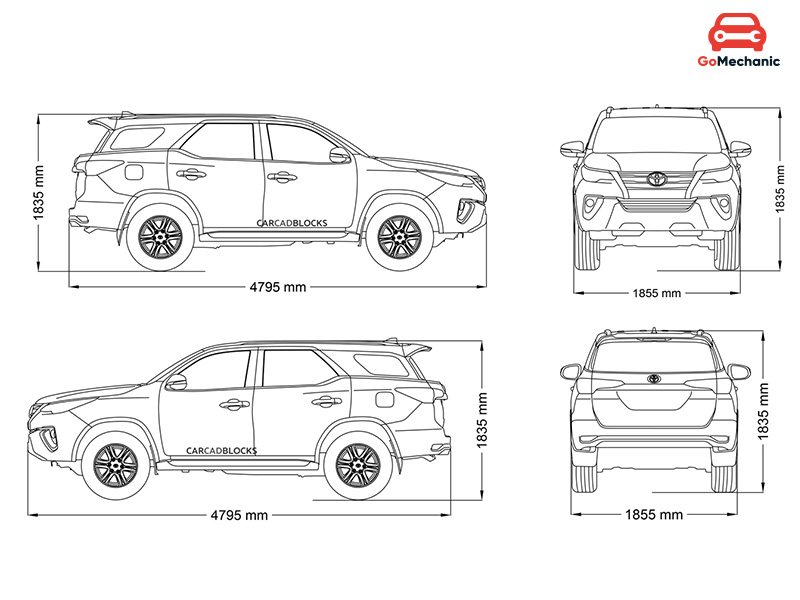
The Fortuner is not a small SUV pretending to look big. It is physically large, and the size of Fortuner confirms that. The overall length of the Fortuner car in feet is 15.8 feet, which translates to about 4,795 mm. That length directly affects parking ease and turning in tight city roads. It’s width stands at around 1,855 mm, so it occupies proper lane space. On highways, this adds stability. In narrow streets, it demands awareness. The height is about 1,835 mm, which explains the commanding seating position and strong road presence. Plus, the wheelbase is close to 2,745 mm, that distance between the front and rear wheels contributes to cabin space and stability. Ground clearance is approximately 225 mm, which helps on rough roads and bad speed breakers. These Fortuner car dimensions are not just numbers. They explain why it feels planted at high speeds, yet slightly demanding in compact urban areas. Size gives confidence, but it also requires judgement while driving.
| Specification | Measurement |
| Length | 4,795 mm (≈ 15.8 feet) |
| Width | 1,855 mm |
| Height | 1,835 mm |
| Wheelbase | 2,745 mm |
| Ground Clearance | 225 mm |
Toyota Fortuner Dimensions – Internal Measurements
When people talk about the size of Toyota Fortuner, they usually focus on the exterior. But internal space is what you live with daily, and numbers help explain the real picture. This is a three-row SUV, so layout and measurement both matter. Front headroom is around 964 mm, so tall drivers do not feel restricted. Rear headroom is close to 933 mm, which remains comfortable for most adults.
Legroom is where the difference becomes clearer. Front legroom is roughly 950 mm, while rear legroom is about 854 mm. That is why the first two rows feel spacious enough for long drives. Shoulder room is also generous, which helps when three passengers sit in the second row. The third row, however, is more occasional use. It works, but not equally comfortable for taller passengers. Boot space depends on seating setup. With all three rows up, luggage capacity is around 296 litres. That limits what you can carry on a full seven-seat trip. Fold the third row down, and it expands to roughly 716 litres. Now it becomes practical for highway travel with proper luggage. These Toyota Fortuner dimensions internally show a clear pattern. First two rows focus on comfort. Third row remains functional. Boot space adjusts depending on usage. The numbers explain the experience more than marketing ever could.
| Internal Specification | Approx Measurement |
| Seating Capacity | 7 |
| Front Headroom | ~964 mm |
| Rear Headroom | ~933 mm |
| Front Legroom | ~950 mm |
| Rear Legroom | ~854 mm |
| Boot Space (All Rows Up) | ~296 Litres |
| Boot Space (3rd Row Folded) | ~716 Litres |
These figures explain the layout clearly. First two rows are comfortable for adults. Third row is usable but tighter. Boot space improves significantly once the last row is folded.
Toyota Fortuner Dimensions – Weight & Fuel Tank Capacity
Weight changes how the Fortuner feels more than most people realise. The kerb weight sits around 2,000 to 2,100 kg (depending on variant), that gives it highway stability at speed. In city traffic though, that same weight makes low speed manoeuvres slightly difficult. Now, size is one part of usability. Range is another. The Fortuner carries an 80 litre fuel tank, and that matters on long highway runs. With the diesel engine and steady cruising, range can cross 700 to 800 kilometres on a full tank depending on driving style. Fewer stops. Longer continuous stretches. Weight defines how it drives. Tank capacity define how far it goes. Both affect ownership in real conditions.
Toyota Fortuner Dimensions – Turning Radius & Off-Road Angles
Length and width tell only half the story, manoeuvrability completes. The turning radius is around 5.8 metres, which means U-turns in tight city roads need space and some patience, especially in crowded areas. It is manageable for a full-size SUV, but it does not rotate as easily as smaller crossovers, that much is clear. Off the road, the geometry works in its favour. The approach angle is about 29 degrees and the departure angle is close to 25 degrees, which helps when climbing steep inclines or exiting uneven ground without scraping the bumpers.
Comparison of Toyota Fortuner Car Dimensions with Rivals
Image here – Collage of Car
| SUV | Length (mm) | Width (mm) | Height (mm) | Wheelbase (mm) | Ground clearance (mm) |
| Toyota Fortuner | 4795 | 1855 | 1835 | 2745 | 225 |
| MG Gloster | 4985 | 1926 | 1867 | 2950 | 210 |
| Isuzu MU-X | 4825 | 1860 | 1860 | 2845 | 230 |
| Jeep Meridian | 4769 | 1859 | 1698 | 2782 | 214 |
| Skoda Kodiaq | 4697 | 1882 | 1665 | 2791 | 140 |
In Short:
- Fortuner vs Gloster: Gloster is just bigger, longer and wider and taller, so it feels more “full-size” in tight spaces too. Fortuner is slightly easier to place in city lanes.
- Fortuner vs MU-X: MU-X is a touch longer and has more ground clearance, Fortuner is slightly shorter which helps in parking. On road presence, both look big.
- Fortuner vs Meridian/Kodiaq: Meridian and Kodiaq are lower and feel less tall-SUV, easier in basement ramps and city handling. Fortuner feels taller and more commanding, but also more “big” in daily use.
Conclusion
The Toyota Fortuner dimensions confirm that it is not large only in perception. With nearly 4.8 metres in length, over 1.8 metres in width, a tall stance, long wheelbase, and strong ground clearance. These external dimensions explain the road presence. They also explain why tight city driving demands planning. Inside, the pattern continues. First and second rows are genuinely spacious. The third row is usable, but more occasional. Boot space changes depending on seating configuration, which directly affects how you use it. Fold the last row and it becomes a proper touring SUV.
Weight and fuel tank capacity complete the practical picture. Around two tonnes of mass gives highway stability. An 80-litre tank supports long-distance travel with fewer stops. Turning radius and off-road angles show that size is supported by geometry, not just metal. When compared with rivals like Gloster, MU-X, Meridian, and Kodiaq, the Fortuner sits in the middle ground. Big enough to feel dominant, yet balanced enough to remain manageable. Toyota Fortuner dimensions are not just brochure number, they actually effect how the vehicle is driven, how it carries people, and how it fits into daily Indian driving conditions.
FAQ’s
1. How long is a Fortuner in feet?
The length of the Fortuner in feet is about 15.8 feet, which comes from roughly 4,795 mm overall length, placing itself firmly in the full-size SUV category and you can feel that in daily driving. It occupies proper road space and needs calculated steering inputs in tight lanes.
2. What is the length of Fortuner in 2026?
The 2026 Toyota Fortuner continues with an overall length of around 4,795 mm, as there has been no major structural change in the current generation. The body dimensions remain largely the same across recent model years.
3. How much parking space is required for a Fortuner?
You need roughly 16 to 17 feet of straight parking length to park it comfortably without constant adjustment. Turning radius of around 5.8 metres means basement parking requires more steering correction. It fits in standard SUV slots, but space margin should not be tight.
4. What are the common problems with Fortuners?
Common complaints include firm suspension setup and noticeable diesel engine noise in older variants. Some earlier automatic versions had slower shift response compared to newer calibrations. Maintenance is dependable overall, but replacement parts are not inexpensive. It is durable, yet not low-cost to repair if major components fail.
5. Is Fortuner difficult to drive in city traffic?
It is not difficult, but it requires awareness because of its width and length. Narrow lanes and sharp turns need measured steering inputs. Parking cameras assist, but physical dimensions remain unchanged. Drivers adapt to it over time, but compact it is not.
6. Does Fortuner feel stable at high speeds?
Yes, highway stability is one of its stronger traits due to weight and long wheelbase. At sustained high speeds it feels settled and planted. Body movement is controlled, though not sporty. Stability comes from mass and chassis tuning.
7. Is Fortuner good for long-distance touring?
With an 80-litre fuel tank and diesel efficiency, range can approach 700 to 800 kilometres depending on driving pattern. First and second rows offer adequate comfort for extended travel. Third row is better suited for occasional use rather than continuous long journeys.


