






When we talk about the car engine of the automobile, we will mention it as the heart of the car. But there is something that keeps engine running smoothly, do you know that? That little part is small, but it is extremely important, that is the spark plug. Without this part, there would be no spark to ignite mixture of air and fuel inside the engine. That means the car, bike, scooter, etc., won’t go anywhere. The engine won’t fire up without this little part. Have you ever asked yourself what a spark plug is and how it works? Here, in this blog, we will explain what is a spark plug, its working, types, and which one is best for you, so that you understand why this little part sits so heavily when it comes to your vehicle’s performance.
What is a Spark Plug?
A spark plug is a little device that is threaded into the cylinder head of a combustion engine. It is meant to produce the spark that ignites the mixture composed of air and fuel, side-by-side in the combustion chamber of the engine. It is this small explosion that powers the engine which, in turn, propels the vehicle. An insufficient spark or otherwise would lead the engine to be unable to start or cause undesirable performance. When the engine completes a full cycle (intake, compression, combustion and exhaust) the spark plug fires the mixture in combustion at the exact moment requested for combustion. The spark plug is a small item, but if it is defective, or simply old and has wear, the issues can be significant. You may experience misfires, little power delivered, and other miscellaneous quirks.
Related blog: MPFI Full Form and How It Improves Your Car’s Performance
Why Do Different Spark Plugs Exist?
Not every engine is built the same way, a small engine for a scooter is totally different from a big engine for an auto. If we take two different models of a car, sometimes even different types of spark plugs are demanded. Spark plugs vary in material, size, and shape because the engines vary in size, in horsepower output, and in design in general. Let us go through different types of spark plugs and how they can affect engine performance.
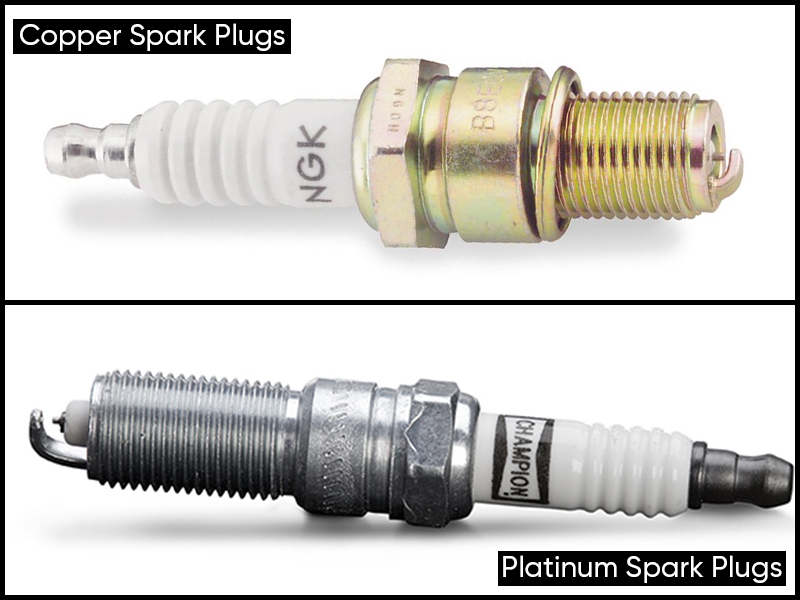
Copper Spark Plugs
Copper plugs are considered basic plugs and are commonly used, especially in older vehicles. The interior of such plugs is copper, which is normally covered in a nickel alloy.
Performance of Copper Plugs: Copper plugs perform well in igniting an engine from a low-voltage ignition. They are such good conductors of electricity that the spark generated will always be strong and steady. However, since nickel wears down quickly than some other metals, copper spark plugs generally need to be replaced more often. Low-compression and rather simple-engine type vehicles are great candidates for copper plug implementation as they are cheaper than the others, so most of the small-budget users go for them.
| Pros | Cons |
| Good electrical conductivity: Copper conducts electricity so well that sparks produced are hot and strong. | Short lifespan: A nickel alloy coating on copper spark plugs wears out quickly, sometimes requiring replacement after 10,000 – 20,000 km. |
| Lower cost: These plugs are the cheapest of spark plugs, which makes them the best choice for a tighter budget. | Higher frequency of maintenance: They will need to be checked and replaced more often than other types of plugs. |
| Works well with older engines: They work very well in simple, low-compression engines often found in older vehicles. | Not as good for modern engines: However, modern cars require higher durability and efficiency than copper can deliver. |
Platinum Spark Plugs
It is a fact that, copper spark plugs belong to the most basic types of spark plugs. Here, when platinum spark plug comes in, a small disc of platinum replaces the nickel and is fitted into the center electrode of the plug. Since platinum is harder than nickel, the spark plug is more durable.
Performance Impact of Platinum Plugs: They’re ideal for engines equipped with electronic ignition systems, since the plugs last longer and don’t have the consistency of sparks over time. They may also improve fuel efficiency and emissions because the cleaner spark plug needs less frequent maintenance to perform at its best.
| Pros | Cons |
| Longer lifespan than copper: Platinum is harder and can hold out against heat better than copper, so it tends to last ~60,000 km. | More expensive than copper: Platinum does affect the price, but it’s not as much affordable. |
| Helps with fuel economy: Cleaner burning causes the engine to run more efficiently, thus raising fuel mileage slightly. | Not ideal for high-performance engines: Platinum may not last in the extreme heat or pressure of a performance engine. |
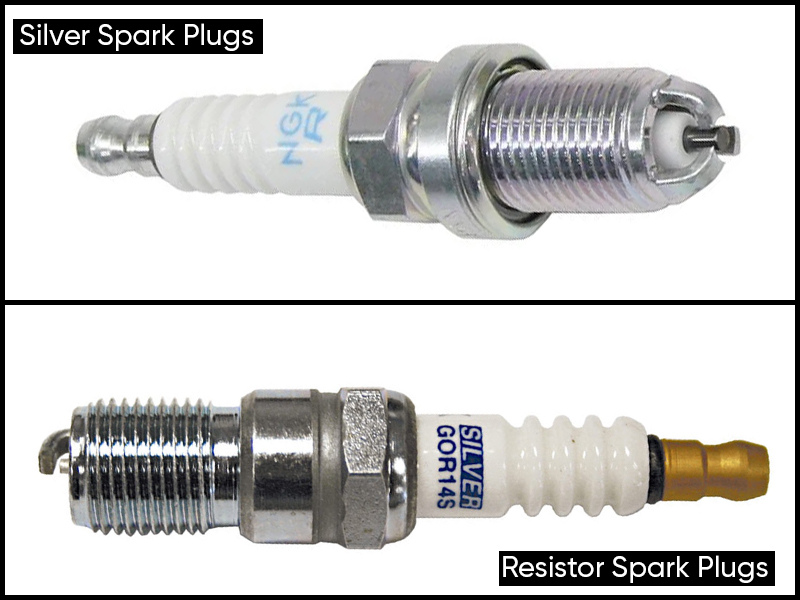
Silver Spark Plugs
Silver spark plugs make use of silver electrodes, which are excellent conductors of electricity, offering a strong spark and better heat transfer than some other materials. These plugs find application in highly specialized uses, such as in certain motorcycles or performance engines, where the emphasis is placed on conductivity and heat dissipation.
Performance and Impact: Silver plugs provide a medium heat range, arguably the best conductivity, and medium lifespan. They often appear in custom motorcycles or performance engines where much importance is attached to spark conduction but to a lesser extent with the other plug materials.
| Pros | Cons |
| Good conductivity: Silver electrodes deliver a strong and continuous spark. | Limited supply: They are not as widely used as copper, platinum, or iridium plugs. |
| Better heat dissipation: Helps prevent overheating and fouling in a minority of engines. | Medium life: Not as long lasting as platinum or iridium plugs. |
| Great for niche engines: Usually used on specific motorcycles or performance engines. | Not for every engine: They aren’t suitable for general passenger vehicles. |
Resistor Spark Plugs
The resistor spark plugs are equipped with a resistor to prevent electrical disturbances to vehicle electronic equipment such as radios and sensors. Common in modern cars, these appliances prevent RFI while still giving adequately reliable ignition.
Performance and Impact: These have usually higher heat ranges, good conductivity, and medium lifespans. They’re needed in vehicles with heavy electronics systems to prevent RFI and other issues caused by electrical noise.
Also read about, Understanding the Knock Sensor: All in One Guide
| Pros | Cons |
| Reliable performance: Provides steady ignition in electronics-heavy vehicles. | Medium durability: Doesn’t last as long as iridium or platinum. |
| Standard in modern vehicles: Necessary for preventing radio frequency interference (RFI). | Higher heat range: May not fit engines requiring colder plugs. |
Non-Resistor Spark Plugs
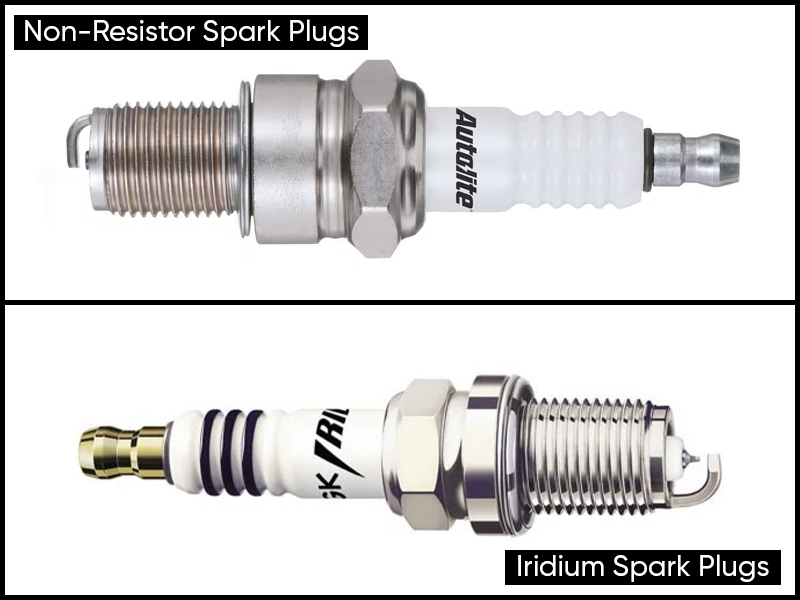
Non-resistor spark plugs do not have any resistance, hence, they allow maximum conduction of sparks. These are mostly used in the older and simpler engines without any sensitive electronics. Although they give strong spark performance, they sometimes are not suitable with electronic systems in the modern era.
Performance and Impact: These plugs are low in heat range and provide excellent conductivity. These are generally used in older or simpler vehicles without any sensitive electronics, or in some performance applications where maximum spark strength is prioritized over electronic interference.
| Pros | Cons |
| Maximum spark conductivity: No resistor means less resistance and stronger spark. | Causes interference: Not suitable for modern vehicles with electronics. |
| Lower cost: Generally cheaper than resistor spark plugs. | Limited modern use: Phased out in most new vehicles. |
| Good for older engines: Ideal for simple, older engines without sensitive electronics. | Potential radio noise: Can cause radio and sensor disturbances. |
Iridium Spark Plugs
Premium spark plug is considered to be iridium. Iridium is one of the hardest metals with excellent durability and heat resistance, thus it can withstand the high-temperature and pressure conditions of modern engines.
Performance and Impact: Impact of performance of iridium plugs Iridium plugs offer excellent durability and fine performance. They give a thin, strong spark, improving the engine response and acceleration and also fuel economy. They go on to last far longer than copper or platinum plugs, sometimes going on for well over 100,000 kilometers.
| Pros | Cons |
| Longest lifespan: Iridium’s durability and heat resistance can allow these plugs to surpass 100,000 km in some vehicles. | Highest cost: The plugs are the most expensive set of spark plugs due to their infrequent metal, and the complex manufacturing process. |
Beyond the main types of plugs above, there are also some advanced ones with different material combinations for better performance or longevity, depending upon your requirements.
Double Platinum Plugs
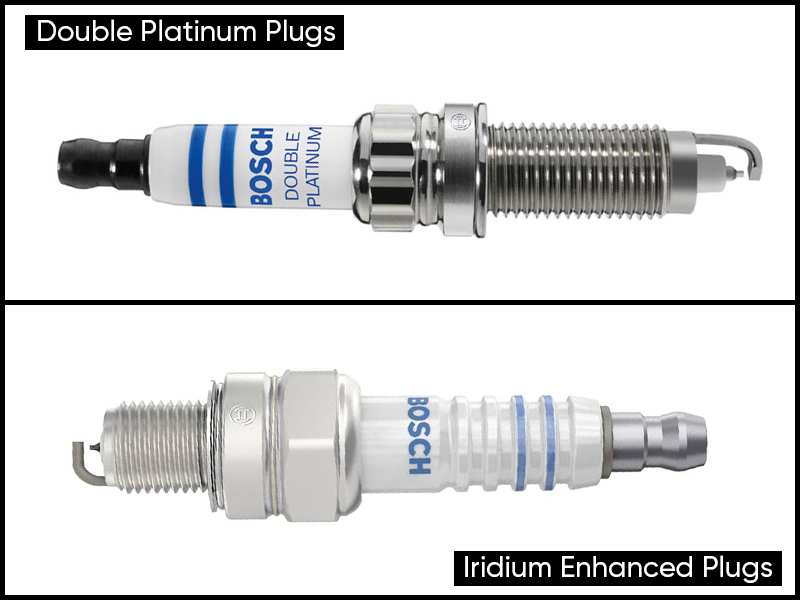
Double platinum plugs have platinum on both the center electrode and the ground electrode. These plugs are used in engines with a waste spark ignition system. In these engines, the spark plug fires twice as often as does its counterpart in a conventional engine.
| Pros | Cons |
| More durable: More resistant to wear and provides a longer life span than single platinum plugs. | Limited benefits for some engines: Provides no real benefit in an engine that does not contain a waste-spark system. |
| Stable performance: Provides stable spark and ignition quality over time. | Still isn’t as durable as iridium: Won’t last under extremely high temperatures, nor does it have the long life span like iridium plugs. |
Iridium Enhanced Plugs
Iridium-enhanced plugs are manufactured with a mixture of iridium and other materials. They help the engine to easily start burning fuel lingering inside the cylinder and hence facilitate easy ignition with better performance than regular platinum plugs. These plugs are less expensive compared to full iridium plugs and still give better results than the standard plugs.
| Pros | Cons |
| Balanced performance and cost: Offers most of the benefits of iridium plugs but at a lower price point. | Not as long-lasting as full iridium: While better than platinum, it still doesn’t match the endurance of pure iridium. |
| Improved ignition efficiency: Better combustion than copper or platinum due to improved electrode materials. | Still more expensive than basic plugs: Costs more than copper and standard platinum, which may not be ideal for budget-conscious users. |
Do read: How to Increase the Car Mileage: The Ultimate Guide for Indian Drivers
How Do Spark Plugs Affect Engine Performance?
The characteristics of the spark plug you select determine the way that your engine performs. Here is how:
- Starting and Acceleration – More spark means your engine will turn over faster and accelerate better when you press the pedal.
- Engine Longevity – Correct spark plugs can create lower stress on the engine/glass fiber components by enabling smoother combustion, in turn extending engine life.
- Emissions – Incomplete combustion with cylinders underfiring can create pollution. The better quality spark plugs, ie, iridium, create fuel economy and lower emissions.
- Maintenance Needs – High quality spark plugs require less maintenance than low better quality ones. For example, iridium spark plugs do not require a good service change for many years, reducing time and maintenance costs/service appointments.
- Fuel Efficiency – Old or incorrect spark plugs can result in you burning more fuel than you should. Iridium and platinum spark plugs enable combustion which maintain more fuel economy.
Which Spark Plug Should You Go For?
The model of a spark plug that best works for you relies on your vehicle, driving style, and wallet.
- Copper plugs will be a cheap plug for an old vehicle or motorcycle with a simple engine. They need to be torqued more often.
- For a newer car, platinum plugs provide maximum fuel economy for a long duration of service.
- If it is a performance vehicle or just want to pay for the best fuel economy and service life, iris plugs could be your next choice.
Of course, you should follow your vehicle manufacturer’s recommendations. Using the wrong type of spark plug will actually cause performance to drop and could even damage the engine over time.
Final Thoughts
Now that you have understood what a spark plug is and the various types of spark plugs, then it must be clear to you how big a role this tiny component plays in engine performance. Whether it is starting your car-freezing cold morning giving you smooth acceleration or saving fuel, the spark plug is at the center of all. The spark plug you choose is not about buying the most expensive one but about choosing the one that is best suited for your engine and your driving style. The knowledge of types available-copper, platinum, iridium, and more-will give you the upper hand in selecting the right plug that will keep your vehicle running smoothly and efficiently for many more years to come.
FAQs
1. Does the spark plug make a difference in the car?
Yes, we can say that any type of spark plug can affect engine performance. They also affect fuel efficiency, and the reliability of ignition.The factors for the same may include the spark plug’s material, heat range and design. These determine how well the spark ignites the air-fuel mixture.
2. What type of spark plug will give the best performance for vehicle?
Iridium plugs are generally considered to be the best performers. It is due to their strength, high melting point, and uniformity of construction. These plugs are perfect for high-performance applications and some of these newer engines.
3. What kinds of spark plugs are there?
There are four primary types of spark plugs: copper, platinum, double platinum, and iridium. A certain difference exists between each type in terms of durability, conductivity, and price. Copper spark plugs are the cheapest, and iridium plugs are the quickest and longest lasting.
4. Does horsepower get affected by different plugs?
Spark plugs alone do not make much horsepower, but performance spark plugs, iridium or fine-wire style, may increase a small amount of power. As they make ignition process more efficient.
5. Does Iridium plugs actually increase the performance?
Yes. Iridium spark plugs does produce a stronger, more consistent spark. This helps in better combustion, smooth acceleration and good fuel economy compared to standard plugs.


