






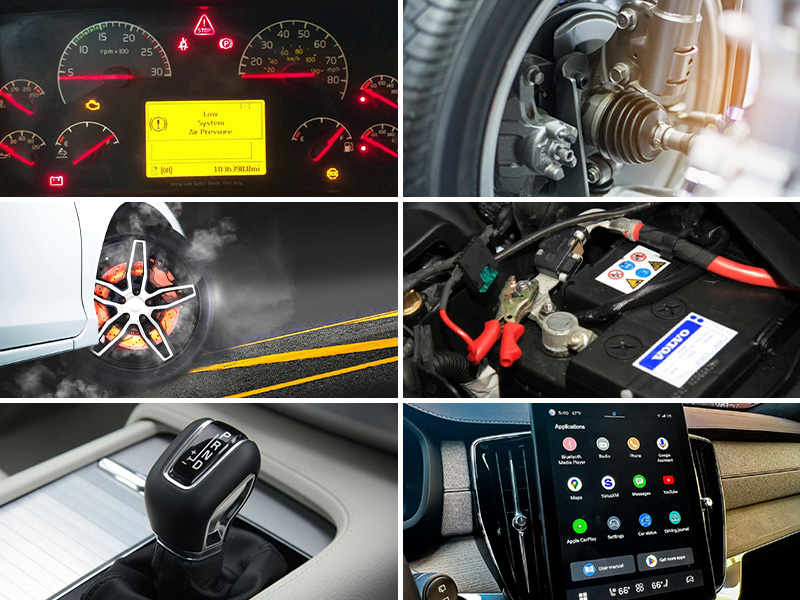
Volvo isn’t just another luxury brand producing Scandinavian-style cars, and a standard of safety across the industry & known for the innovation of some of the most common safety features in today’s cars. It’s the go-to brand for people seeking cars with solid engineering & performance without screaming for attention. But like any other car brand, even Volvo isn’t perfect. Over the years, Volvo owners, especially in India, have reported a few recurring issues that buyers should know before buying one. In this blog, we will discuss Volvo’s common problems people are facing, like Infotainment & Touchscreen Lag, Gearbox & Transmission Jerks, Battery Drain & Electronic Malfunctions, Brake Wear & Squealing Sounds, Suspension Clunks & Ride Comfort Issues, Fuel Injector or DPF Issues (Diesel Models), and their possible solutions, respectively.
Thus, here’s a list of Volvo common problems reported by the owners of Volvo cars:
Must read: Upcoming Volvo Cars in India 2025
Volvo Common Problems Include:
1. Infotainment & Touchscreen Lag
Problem:
Volvo’s infotainment system is one of the Volvo Common problems, especially reported mostly in the case of models in the XC series, which is known for minor hiccups—Laggy touchscreen, random unnecessary reboots, delayed app opening, Bluetooth disconnects, and sometimes users even face complete blackouts where the screen goes blank or becomes completely unresponsive.
Solution:
- Software Update: Volvo does push over-the-air (OTA) updates, but they aren’t always automatic in India. Visiting the service center to manually get the latest version can fix 90% of these bugs. Make sure your vehicle is running the latest firmware.
- Factory Reset: The company, due to a high number of complaints about the issue, suggested that its users of such models perform a hard reset, which could bring the system back to normal and responsive. Users could do this via the settings menu or ask the workshop technician to reset the module using their diagnostic tools.
- Keep the Storage Clean: Avoid loading unnecessary apps and always delete unused connected services or devices. A lighter system runs better.
2. Gearbox & Transmission Jerks
Problem:
Volvo owners reported gearbox and transmission jerks as one of the Volvo common problems, particularly of older XC60, S60, and a few of the XC90 models, which have repeatedly reported jerky shifts, gear hunting, or noticeable delays during acceleration. The reports have been of vehicles feeling sluggish off the line or suddenly moving forward with a jerk as they catch the right gear. This makes city traffic frustrating.
Solution:
- Transmission Fluid Health: Unlike some Japanese cars, Volvo’s transmission fluid needs timely replacement—ideally every 60,000-80,000 km in Indian stop-and-go traffic. Worn-out fluid leads to friction loss and erratic shifting.
- Software Recalibration: The company reported that most of these reports were due to an issue not in the hardware or mechanical parts, but in the software of the car. A Transmission Control Module (TCM) reset or update helped solve these delays or jerking issues.
- Gentle Driving After Reset: Post-resetting the car, driving it gently for a few hundred km would allow the adaptive system to relearn your style. Which eventually would bring back smoother shifting.
Also read: Volvo Cars in India: Safety, Luxury, and a New Era
3. Battery Drain & Electronic Malfunctions
Problem:
Modern Volvos are loaded with electronics—from radar-based ADAS, blind spot monitors, 360-degree cameras, and collision mitigation systems. But the flip side? Battery drain becomes one of the Volvo common problems, especially if the car is parked for a few days. Phantom warning lights, auto-light failures, and random sensor glitches are common.
Solution:
- Scheduled Battery Checks: Like any other car, a regular checkup of the battery could solve such issues, especially in cases of such luxury cars, being heavily electronics loaded and having high dependency on the battery, and even more in case of plug-in hybrid variants like the XC90 Recharge, or if you frequently use features like Pilot Assist and parking cameras.
- Use a Trickle Charger: Leaving your car unused for long? A smart trickle charger keeps your battery healthy and prevents unnecessary low-voltage errors across ECUs.
- Get a Diagnostic Scan: If the instrument cluster lights up like a disco, get a full diagnostic scan at the workshop. 9/10 times, it’s just a software misfire or voltage drop, not a hardware issue.
4. Brake Wear & Squealing Sounds
Problem:
Volvo uses high-performance brake pads, which are excellent for stopping power but tend to wear quickly in Indian conditions, which has now become Volvo common problem. Users complain of squealing noises, spongy brake feel, and sometimes even brake judder after just 15,000-20,000 km of city use.
Solution:
- OEM Brake Pads Only: Many users who faced such issues were found to be using non-OEM pads. However, in a few cases, these pads were more performance-oriented than the OEMs, but they still weren’t well-suited for the car. Thus, upgrades to these parts should only be done after thorough research, or an easier way is to always stick with manufacturer-recommended parts.
- Inspect Calipers Too: Sometimes the issue isn’t with the pad but with sticky calipers or improperly lubricated slide pins. Always get the full brake assembly inspected—not just the pads.
- Heavy Stop-Go Traffic: Frequent braking in heavy city traffic could wear off pads quickly. If you mostly drive in such urban conditions, check the pads every 12,000-15,000 km.
You can read: Volvo Most Expensive Car in India 2025: The Volvo XC90 Recharge
5. Suspension Clunks & Ride Comfort Issues
Problem:
A few Volvo models, mostly in the case of the XC60 and XC90, after a specific distance, and that too on the Indian road driving conditions, developed clunky suspension noises, rattles & uneven ride quality. People have complained about the Air suspension model, as the cars showed signs of compressor failure or sagging corners.
Solution:
- Check Anti-Roll Bars & Bushings: In most of the cases reported, the clunks were due to worn-out rubber bushings, strut mounts, or stabilizer links. These parts, although expensive, need regular inspection, especially after every 25000-30000 km.
- Air Suspension TLC: If your car has air suspension, check for leaks, slow lift, or error messages. Addressing it early can save you from a ₹2–3Lakh replacement bill later.
- Listen for Early Signs: A faint “tuk-tuk” sound on speed breakers is the first warning. Don’t wait until the car feels like a boat.
6. Fuel Injector or DPF Issues (Diesel Models)
Problem:
Diesel Volvos like the XC90 D5 or S90 D4 face DPF clogging, EGR valve errors, and injector failures, especially when they’re mostly driven in urban traffic. Over time, these issues can lead to reduced power, black smoke, and even limp mode.
Solution:
- Stick to Premium Diesel: Low-quality diesel causes unburnt residues, clogging the Diesel Particulate Filter (DPF) and gumming up the injectors. Stick to Indian Oil XP95, Shell, or BPCL Speed.
- DPF Regeneration: Take your Volvo on the highway once a week for a 20-30 minute drive at higher RPMs. This allows passive regeneration of the DPF. If not, you might need a forced regen at the dealership.
- Injector Maintenance: Get your injectors cleaned every 30,000 km. Adding a diesel additive (recommended by Volvo) occasionally can also help extend life and fuel efficiency.
Conclusion
Volvo is a premium brand known for safety and solid build quality. But that does not mean these cars are free from problems. Like every car, Volvo also faces issues. Volvo common problems include infotainment & touchscreen lag, gearbox & transmission jerks, battery drain & electronic malfunctions, brake wear & squealing sounds, suspension clunks & ride comfort issues, and fuel injector or DPF issues (diesel models). All these problems have solutions too, which are mentioned in the above blog. If you are planning to buy a Volvo, then you must know Volvo common problems. Regular servicing, use of OEM parts, and running the car timely instead of leaving it idle can control these problems to a great extent. Volvo is a comfortable, safe, and powerful car; it just needs a little care. If you adopt a smart ownership approach, then Volvo can be a reliable option for Indian roads, too.
FAQs
- What is the common problem with Volvo?
The most common problems with Volvo cars are their complex transmissions. Some other problems include infotainment & touchscreen lag, gearbox & transmission jerks, battery drain & electronic malfunctions, brake wear & squealing sounds, suspension clunks & ride comfort issues, and fuel injector or DPF issues (diesel models).
- Is Volvo considered a reliable car?
Yes, Volvo cars are considered reliable, especially when it comes to safety. Their build quality is strong and good for long-term use. It is a premium brand, so the standard of the parts and repair is also high.
- Are Volvo car expensive to maintain?
Yes, maintaining a Volvo car is expensive, as it is a luxury brand. Parts are imported, and servicing is also done from an authorised centre. Regular service causes less trouble but cost more than an average car.
- What are the disadvantages of a Volvo car?
Volvo cars are quite safe and stylish but have some disadvantages. Firstly, their maintenance and repair costs are a bit higher, parts are costly and less available, especially in India. Service cenes are also limited compared to other brands. Mileage is a bit low and resale value is also average for some models.


