GoMechanic





Once you begin searching for your new vehicle or SUV you will frequently hear it when 4WD vs AWD is spoken. Initially, they are almost similar in the way they sound yet they work very differently. AWD (All-Wheel Drive) and 4WD (Four-Wheel Drive) – both of them are designed to achieve more grip and control on bad roads. It can actually be useful to know how they operate so that you can choose one that is more appropriate to you. AWD is primarily used in normal driving and in conditions where roads are slippery whereas 4WD is applied in harder situations such as off-roading or steep mountains. This blog will take a step-down and see what both systems entail, how they operate, the key differences between them, and the blog will then decide which driving system fits your style.
1. AWD Full Form: What Does All-Wheel Drive Mean?
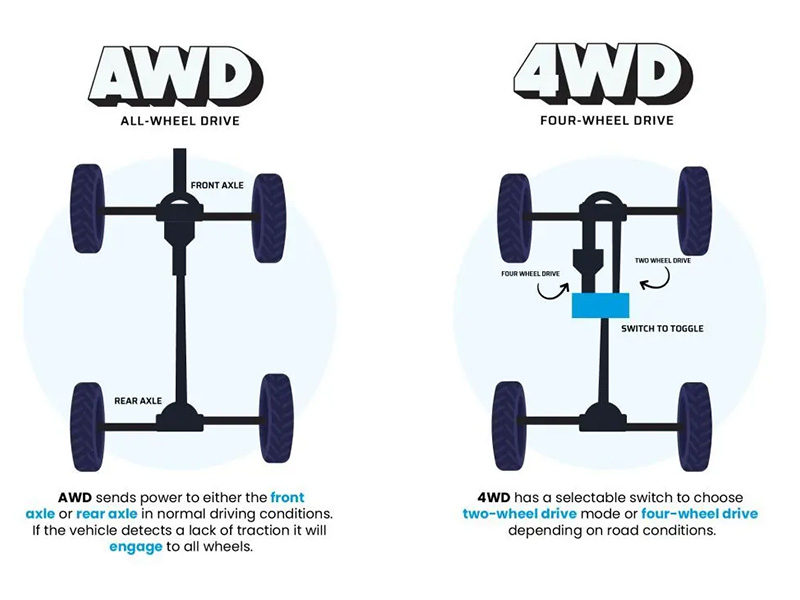
All-Wheel Drive is what AWD stands for. It means that all four wheels receive power at the same time, ensuring that the vehicle stays stable on different kinds of roadways. The automobile does it automatically, so there’s no need to push a button or turn on a mode. AWD is perfect when one drives in the rain, snow or on slightly rough roads. It has good traction and control and you do not even notice it. This system is applied in most cars of today and SUVs as it is convenient and it keeps you safe without any extra effort on the part of the driver.
2. What is AWD and How Does It Work?
AWD systems comprise sensors that detect the wheels that require additional power. Once one of the wheels begins to slip, the rest of the power is given to the other wheels promptly in order to keep the car stable. It has two models: full-time AWD (always on) and part-time AWD (activates when needed). This eases the process of driving and makes it safer, particularly on wet or rough roads. There is no need to think about it – the car does everything. That is the reason why AWD is popular in urban driving and long distances, in case of which the weather conditions may change.
3. 4WD Full Form: Understanding Four-Wheel Drive Systems
What the word 4WD means is Four-Wheel drive and is usually applied to SUVs and off-road vehicles. With a 4WD car, the power may also be sent out to all four wheels at any time, usually by a switch or a button. This provides an additional grip on the road, whether in mud, stones, sand, or snow. 4WD mechanisms are tougher and suited to the extreme conditions that normal vehicles would get stuck in. They suit individuals who go off-road or reside in hilly environments. However, that is not as practical because they are heavy and consume more fuel, which is not good when one has to drive every day in the city.
4. What is 4WD and When Should You Use It?
4WD comes in handy when you’re driving on really bad roads or uneven ground. You should turn it on when you’re stuck in mud, driving uphill on rocks or dealing with slippery roads. It gives more control & power to each wheel, so you don’t lose grip. Some 4WD cars also have a “low range” mode, which helps when driving slowly over big rocks or steep slopes. But it’s not meant for everyday use – driving in 4WD mode all the time can waste fuel and wear out parts faster. So, switch it on only when needed.
5. Differences between 4WD vs AWD: Function and Performance
4WD vs AWD might sound similar, but they work differently. AWD runs automatically and suits normal roads or bad weather. 4WD gives extra power for off-road use or rough terrain. Both are good systems, but each one is made for a different kind of driving need.
| Feature | AWD (All-Wheel Drive) | 4WD (Four-Wheel Drive) |
| How it Works | Automatically sends power to all wheels | The driver can manually switch on or off |
| Best For | City driving, rain, snow, mild off-road | Off-road, rocky or muddy roads |
| Performance Focus | Comfort and stability | Power and control |
| Fuel Efficiency | Usually better | Slightly lower |
| Maintenance | Easier and lighter | More complex and costly |
| Driving Experience | Smooth and convenient | Rugged and powerful |
6. Which is Better – AWD or 4WD?
There’s no single “best” choice between 4WD vs AWD – it really depends on your driving style. AWD is easier for everyday driving and handles rain or snow well. 4WD is tougher and built for off-road adventures or rough roads. Both have their own strengths for different drivers.
| Driving Need | Best Option | Reason |
| City Driving & Highways | AWD | Gives smooth handling and better fuel economy |
| Rainy or Snowy Roads | AWD | Adjusts power automatically for better grip |
| Off-Road or Hilly Terrain | 4WD | Offers more power and control on uneven surfaces |
| Adventure Trips | 4WD | Built for mud, rocks, and tough trails |
| Daily Comfort & Convenience | AWD | No need to switch modes – always ready |
7. AWD and 4WD: Pros and Cons for Everyday Driving
Both 4WD & AWD have benefits and drawbacks. While 4WD offers greater force on off-road trips, AWD is practical and performs well in everyday driving. The area & driving style you regularly use will determine which option is best for you.
| Feature | AWD (All-Wheel Drive) | 4WD (Four-Wheel Drive) |
| Best For | City and highway driving | Off-road and hilly areas |
| Ease of Use | Automatic system, no manual control needed | Needs manual mode selection in most cars |
| Fuel Efficiency | Better than 4WD | Uses more fuel |
| Maintenance | Moderate | Usually higher |
| Traction Power | Good for wet or slippery roads | Excellent for mud, snow, or rocky roads |
| Driving Feel | Smooth and comfortable | Strong and rugged |
Conclusion
Both AWD and 4WD make them safer when driving and provide a higher degree of control, yet they are designed to suit people of different kinds. AWD is ideal when you desire a vehicle that is easy to operate, safe during adverse weather, and comfortable to use in everyday settings. No need to do anything – the car calculates it all automatically, 4WD is better suited to adventure lovers, those who run along hills, sand and muddy roads. It gives more control and power, not necessarily the best when driving in the city. It is not about which one of them is better; it is what you need. AWD is the way to go in case you need comfort and safety. To be strong and have fun off-road, then 4WD is your better choice. They are both useful – but in varying degrees.
FAQ’s
1. Are 4WD and AWD the same?
No, 4WD and AWD are not the same. AWD transmits power to all the wheels automatically & is most suitable for urban roads and small off-road. 4WD is more powerful and can be switched on or off and it is more suitable for heavy off-road. AWD is traction-oriented oriented whereas 4WD is performance-based on rough terrain.
2. Which is best, 4×4 or AWD?
A 4×4 (4WD) vehicle is the best choice for off-road driving, steep slopes, mud & rough roads since it has excellent torque and can be manually controlled. Because AWD automatically modifies the power, it is perfect for daily driving, wet conditions & short treks. Consequently, 4×4 is recommended for serious off-roads and excitement, while AWD is preferred for cities and highways.
3. Is the Fortuner 4WD or AWD?
Toyota Fortuner is not an AWD but a 4WD (4×4). It is equipped with a part-time 4WD system and that is why it can be turned on and off in accordance with the road. The arrangement has great output in rugged off-road conditions such as mountains and sand as well as forest roads and so is a favorite SUV in India.
4. Which Toyota model is AWD?
Many Toyota models are AWD and primarily to provide a better grip on city and highway roads. Toyota RAV4, Highlander, and Camry AWD are the most popular AWD Toyota cars in the world market. Some hybrid versions have been made in India such as the Toyota Hycross with an electric AWD system that enhances traction on slippery roads.
5. What is the weakness of a Fortuner?
The Fortuner is powerful, durable and excellent in the off-road, though it possesses some shortcomings. Its riding performance is harsh, particularly on poor roads. The seating area is small in the 3 rd row. It costs more to purchase and maintain as well since it does not consume as much fuel as the smaller SUVs. Handling on highways is heavier.