GoMechanic




Every luxury car lover in India has had this thought at some point: if you had the cash, would you go for that sleek, fashion-forward Range Rover Evoque or the beastly yet sleek Jaguar F-Pace? Both are British, both carry serious road presence, and both give off premium vibes. But peel back the branding label, and you’ll see two very different personalities under the hood. One is tailored more for urban swagger, while the other is geared towards performance hunger. And you’re probably also wondering about long-term practicality, driving comfort, and whether that 80 lakh price tag buys real means something or just another holo badge. Before we break down the details car by car in this blog about Range Rover Evoque vs Jaguar F-Pace, let’s take a look at where these two really come from and why that matters when choosing between them.
Range Rover vs Jaguar: Brand Comparison
Both Range Rover and Jaguar hail from the United Kingdom, but that’s where the similarities end.
Land Rover built its reputation on go-anywhere capability. You could drop a Defender in the middle of Spiti Valley, and it would find its way back to Mumbai. The Evoque, however, is different. It’s not built for muddy roads but to conquer the urban jungle. This gets Evoque that ‘fashion-first’ premium look without the bulk of a full-sized SUV, designed more for comfort.
Jaguar, on the other hand, has always been about speed with grace. The F-Pace was Jaguar’s first serious attempt at making an SUV, and it didn’t want to feel like a compromise. It behaves like a tall sports car.
So, now that the brand stories are clear, let’s see how Range Rover Evoque vs Jaguar F-Pace compare when it comes to your money.
Range Rover Evoque vs Jaguar F-Pace: Price Comparison
| Variant | Range Rover Evoque | Jaguar F-Pace |
| Base Diesel | ₹72.19 lakh | ₹72.90 lakh |
| Top Petrol | ₹75.38 lakh | ₹78.90 lakh |
At first glance, the prices are nearly the same. But on a root level:
The Evoque, being compact and city-tuned, might feel like a stretch for what it offers on paper. But it bears the Range Rover aesthetic and tag, which justifies it for a lot of buyers. Think of it like buying the flagship iPhone Pro, you are paying for more than just raw specs.
Whereas, the F-Pace gets you a bigger body, more powerful engine and some really impressive hardware, especially on the R-Dynamic trims. So if you’re comparing specs rupee-to-rupee, the Jag might feel like a better value.
But, should you decide purely on numbers and specifications on paper? Not quite. Let’s go deeper.
Get a Good Look – Range Rover Evoque: The Cheapest Land Rover Car in India in 2025
Range Rover Evoque vs Jaguar F-Pace: Dimensions and Chassis Design
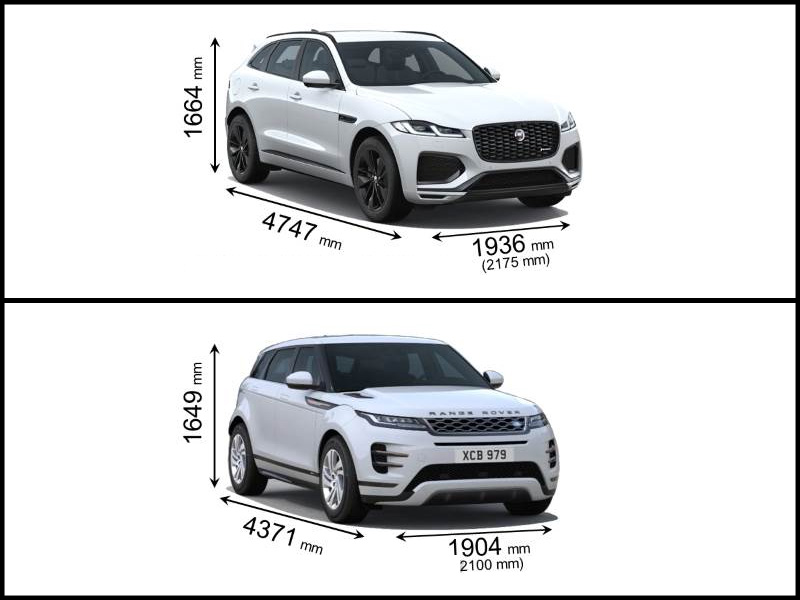
| Specification | Range Rover Evoque | Jaguar F-Pace |
| Length | 4371 mm | 4747 mm |
| Width | 2100 mm (incl. mirrors) | 2175 mm (incl. mirrors) |
| Height | 1649 mm | 1664 mm |
| Wheelbase | 2681 mm | 2874 mm |
| Ground Clearance | 212 mm | 213 mm |
| Boot Space | 591 litres | 755 litres |
The numbers don’t lie, and so the F-Pace is the bigger car. Substantially bigger. Which means more cabin room, more road presence, and frankly, more metal for your money.
Chassis & Platform
The Evoque is built on Land Rover’s PTA platform, which is made for transverse engines and supports mild-hybrid tech. It’s modern, but more urban-focused in terms of ride and handling. It’s not made for hardcore off-roading, but it’ll take on slushy roads and mild trails just fine.
The F-Pace uses Jaguar’s D7a platform, shared with some of its sedans (XF and XE). It’s an aluminium-intensive structure which keeps the car lighter and more agile. And it shows, the F-Pace has that low-slung, planted stance on corners, even if you forget you’re in an SUV.
Range Rover Evoque vs Jaguar F-Pace: Powertrain, Performance & Range
| Variant | Engine | Power (PS) | Torque (Nm) | Transmission | 0–100 km/h |
| Evoque Petrol | 2.0L Ingenium Turbo | 250 PS | 365 Nm | 9-speed AT | ~7.6 sec |
| Evoque Diesel | 2.0L Ingenium Diesel | 204 PS | 430 Nm | 9-speed AT | ~8.5 sec |
| F-Pace Petrol | 2.0L Turbocharged i4 | 250 PS | 365 Nm | 8-speed AT | ~7.3 sec |
| F-Pace Diesel | 2.0L Turbocharged i4 | 204 PS | 430 Nm | 8-speed AT | ~8.0 sec |
Let’s talk numbers, and then let’s talk feel.
Both offer the same 2.0L engine options, but where the Evoque uses a 9-speed transmission (a ZF box, tuned for smoother, softer shifts), the F-Pace runs an 8-speed that’s noticeably quicker to respond. In daily traffic, you may not notice it. But take both out on a highway sprint, and the F-Pace just feels livelier. It surges ahead with more intent. The Evoque, on the other hand, is smoother – almost too smooth, at times.
The ride is quiet in both, thanks to solid NVH insulation, but if you’re someone who loves hearing that low-end grunt from a diesel, the Evoque muffles it a bit more than the F-Pace.
As for range, both average about 11–13 km/l for the petrol variants and up to 17 km/l for the diesels under mixed driving. But let’s be honest, if you’re buying a 75 lakh SUV, mileage isn’t the conversation starter here.
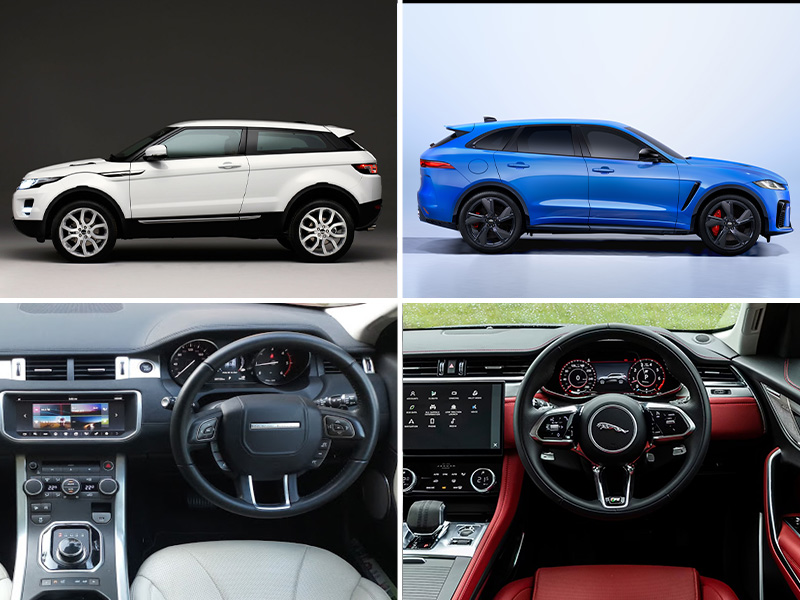
Range Rover Evoque vs Jaguar F-Pace: Interior and Exterior Design
A. Interior Design & Features
The Evoque is minimalistic, almost Apple-esque. You get twin 10-inch touchscreens (Pivi Pro system), a digital driver display, and lots of soft-touch materials. The cabin wraps around you, giving that cocooned, cockpit-like feel. The front seats are plush, but the rear space? A bit tight for taller adults. Think of it as a four-person car, not a family carrier.
The F-Pace, meanwhile, feels broader and more lounge-like. The updated interiors (post-2021 facelift) are genuinely impressive – leather where it matters, open-pore wood, metal switches. You get an 11.4-inch curved Pivi Pro screen, wireless Apple CarPlay, a proper wireless charger, and more legroom than you’ll need unless you’re seven feet tall. It feels more expensive from the inside than it looks from the outside.
B. Exterior Design
The Evoque looks like it was sketched by someone who’s designed for Milan Fashion Week. Sleek lines, flush door handles, sloping roof: very city-oriented. It looks like a concept car that made it to production without being watered down. It’s shorter and tighter, yes, but undeniably attractive.
The F-Pace carries that Jag DNA with pride: long hood, muscular arches, and a sharp rear end. It has the presence of a BMW X5 but still manages to look sporty. After the facelift, the LED headlamps are slimmer, the grille more aggressive, and overall, it looks far more mature than its earlier version.
Range Rover Evoque vs Jaguar F-Pace: Ride Quality & Experience
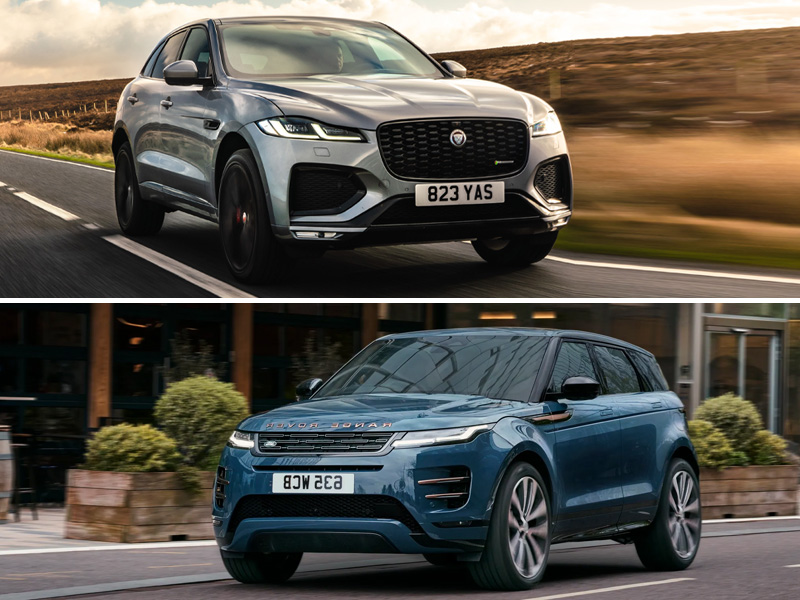
This is where the personalities of these two cars really diverge.
A. Ride Comfort & Handling
The Evoque glides over broken roads with ease. The suspension is tuned for comfort and takes potholes like it’s born for Indian tarmac. But here’s the catch. That cushy setup makes the steering feel too light once you’re past city speeds. It’s smooth for daily drives and traffic, no doubt, but not something you’d want to rely on when the road starts to twist and turn.
The F-Pace gets you a firmer ride, and yes, sharper bumps make themselves known. But the reward is control. It stays flatter in corners, responds to your hands quicker, and gives you that solid, planted feel usually reserved for well-tuned sedans. Jaguar absolutely got the dynamics right. And if you opt for adaptive suspension, it adjusts to your mood like it’s reading your mind.
B. Safety Features
Both cars come loaded, as expected. Here’s what they share:
- 6 airbags
- ABS with EBD
- Electronic Stability Control
- All-Wheel Drive
- Hill Descent Control
- ISOFIX child seat mounts
C. Exclusive Features
Here’s where the differences sneak in:
- Evoque Exclusive: Clearsight Ground View (transparent bonnet view while off-roading), Clearsight rear-view mirror (uses a camera if the rear window is blocked), and Terrain Response 2 system with configurable drive modes. But, no ventilated seats. And that stings in Indian heat.
- F-Pace Exclusive: Active road noise cancellation, powered gesture tailgate, ventilated seats (hallelujah), dynamic driving modes, and a slightly better head-up display. But it misses out on some of the off-road-focused gimmicks because it doesn’t need them. It’s not trying to be a mountain goat.
D. Driving Experience
Now here’s the fun part.
In traffic, the Evoque feels agile and easy to manoeuvre. You sit slightly higher, visibility is solid, and the brakes are progressive. Slotting it into tight parking spots in Mumbai or Bangalore is much easier than you’d expect. It’s a joy to live with daily until you carry three adults in the back.
The F-Pace, however, is made for Sunday morning drives. You can actually drive it, not just pilot it. The 250 PS petrol variant feels alive. Overtaking on highways is effortless. You feel connected to the road, something most SUVs fail at. Sure, it’s larger to handle in cities, but the payoff in fun is immense.
Conclusion
So, in Range Rover Evoque vs Jaguar F-Pace, is there a clear winner?
Here’s the thing. There isn’t because these two aren’t even playing the same game.
- If you’re drawn to compact luxury with serious street style and attention to comfort, the Evoque hits the sweet spot. It’s not built to attack corners. It’s built to gather crowds, and it does that really really well.
- But if what you want is an SUV that drives like it’s got something to prove, the F-Pace is the one. It gives you more room, more performance, more control, and a more connected feel every time you push the throttle. It’s not just good-looking but packs performance too.
Neither is objectively better. It comes down to use case, preference, and what trait you care about: design, drive, badge, or all of the above.
Still stuck without a decision? Here’s a tip: test drive them both on the same day. And before finalising, also peek at options like the BMW X3 or the Volvo XC60 while you’re at it. Even if you’re just exploring, it’ll give you a good grasp on the features you’re looking for.
And in the world of luxury SUVs, that’s the first decision you have to make.
Know more about this – Land Rover Upcoming Cars in India in 2025
FAQs
1. Is F-Pace bigger than Evoque?
Yes, clearly. F-Pace is longer, wider, and has more room inside. You’ll notice it in the rear seats and boot space. Evoque feels compact, city-friendly. F-Pace feels like a proper SUV with muscle. If size, comfort, or highway trips matter for you, go with F-Pace.
2. Which is better, Jaguar or Range Rover SUV?
If you enjoy driving, go for Jaguar. The F-Pace feels like a car. Steering’s quick, handling’s tight, and it leans sporty without trying too hard. It wants to be driven fast. Range Rover’s about experience. The Evoque is calm, composed, and feels plush even on bad roads. You sit higher, glide through traffic, and everything around you feels slower, in a good way.
3. What’s replacing the Jaguar F-Pace?
Nothing directly. Jaguar is ditching engines and going electric by 2025. A new EV GT is coming first, then electric crossovers later. But the F-Pace as we know it (engines, drive feel, old-school thrill) is on its last lap. So if you want one, now’s the time. The electric future won’t bring it back in the same way.
4. Which Jaguar F-Pace is top of the range?
Globally, it’s the SVR. A 5.0L V8 beast with 550 PS. Fast, loud, proper old-school car. But India doesn’t get it. We get the R-Dynamic HSE, which still packs serious kit: adaptive suspension, Meridian audio, big alloys, and sharp styling. You get petrol or diesel, both 2.0L. It’s the best you’ll find here.
5. What is the Range Rover equivalent of the F-Pace?
It’s the Range Rover Velar. Same platform, same engines. But Velar is built for luxury, not speed. It glides, feels minimal, and pampers you. F-Pace is sharper to drive, more fun in corners. So Velar is for presence, F-Pace is for performance.
Want to Compare More Cars in India? Read these:
- Mercedes GLC vs Volvo XC60 – A Detailed Comparison
- MG ZS EV vs BYD Atto 3: An Honest, Detailed Comparison that Helps You Decide
- Jeep Compass vs Volkswagen Tiguan – Comparison of Individual Aspects
- Hyundai Kona EV vs MG ZS EV: Who Wins the Battle of EVs
- Kia Sonet vs Brezza—Which Compact SUV Deserves Your Garage?
- MG Comet EV vs Tata Punch EV – Complete Comparison
- Kia Sonet vs Mahindra XUV 3XO – Which One’s Right for You