GoMechanic





All vehicle owners in Gujarat are required to pay road tax in order to use public roads legally. This tax, which is part of the vehicle registration process, is imposed by the state. The road tax money is invested in better road conditions, highway expansion, and the transportation infrastructure in the cities, industrial areas, and rural areas.
This well-explained blog will simplify the entire road tax system in Gujarat. It not only discusses how the tax is calculated but also provides information on payment methods and penalties which is every vehicle owner’s concern.
Meaning of Road Tax & Who Has to Pay It?
In Gujarat, road tax is generally applicable as a one-time payment during the vehicle registration process. This tax is applicable to all vehicles irrespective of their purpose, whether they are for private use or commercial use. In the case of a vehicle that has been bought in another state and later brought to Gujarat for permanent use, it is obligatory to re-register the vehicle and pay the road tax of Gujarat.
Road tax is levied on:
- Two-wheeled vehicles
- Private cars
- Three-wheeled vehicles
- Commercial vehicles both for passenger and freight
- Specially designed vehicles like cranes, trailers, and campers
The amount of tax that a vehicle owner has to pay is determined by the type of vehicle and its specifications.
How Road Tax in Gujarat Is Determined?
The amount of road tax in Gujarat is decided after taking into account a number of vehicle-related factors:
- Vehicle category (bike, car, or commercial vehicle)
- Fuel type (petrol, diesel, or electric)
- Engine capacity
- Seating capacity in passenger vehicles
- Vehicle price mentioned on the invoice
Diesel-powered cars are usually taxed more than petrol cars. Likewise, vehicles with bigger engine capacity or higher value are subject to higher taxes. For commercial vehicles, weight and seating capacity are the main factors that affect the final tax.
Do read: Road Tax in Delhi: Complete Guide to Payment, Online Process, and Refunds
Gujarat’s Road Tax for Private Cars
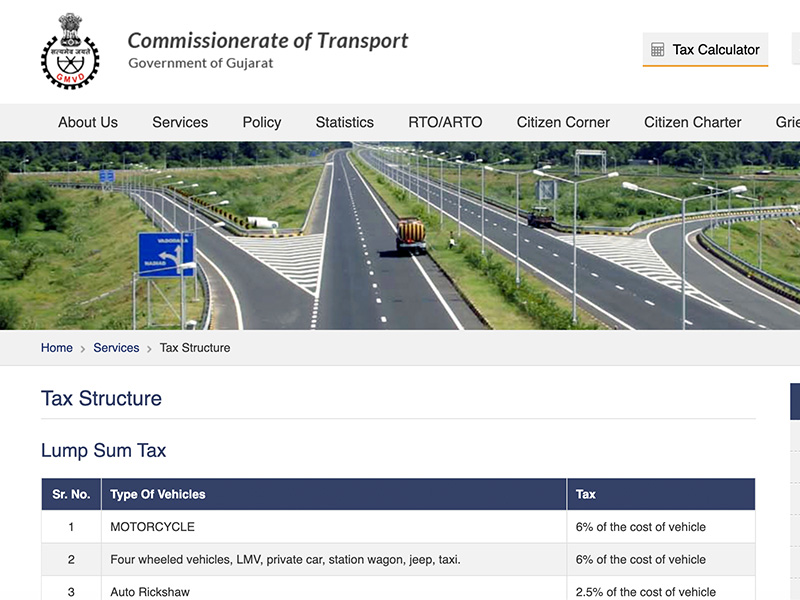
In Gujarat, private cars registered for personal use are subject to a one-time road tax during the registration process. The tax is usually computed as a percentage of the vehicle’s price.
Overall:
- The cheapest petrol cars are taxed the least.
- The mid-range ones are taxed at a medium pound.
- Diesel cars are charged in the same way as the petrol cars within that segment, except they are more.
- Luxury and high-end cars are taxed the most.
- Battery-powered vehicles temporarily exhibit the right to mainly or no road tax in accordance with the existing government’s policy.
Road Tax for Two-Wheelers in Gujarat
In Gujarat, two-wheelers are among the most favored means of transport. The road tax for these vehicles is usually determined by the engine size and the total price paid for the vehicle.
The common tax brackets consist of:
- Up to 100 cc – Very low road tax
- 101 to 150 cc – Average tax
- Over 150 cc – High tax
The daily commuter motorcycles are taxed less, while the premium and sports motorcycles are in the higher tax bracket.
Road Tax for Commercial Vehicles in Gujarat
The commercial vehicles in Gujarat are subjected to heavy taxation since they are mostly in use and they also cause the most damage to the roads. The tax structure is determined by the purpose of the vehicle. The passenger commercial vehicles such as taxis, buses, and school vans are taxed according to the number of passengers they can carry. Larger vehicles are subjected to a higher tax rate. The goods vehicles like trucks and transport carriers are taxed based on their Gross Vehicle Weight (GVW). The heavier vehicles are levied with a higher tax because they contribute to the rapid deterioration of the roads.
Road Tax for Three-Wheelers and Special Vehicles
In Gujarat, three-wheeled vehicles come under a distinct road tax regime. Passenger auto-rickshaws are taxed according to their carrying capacity, while goods auto-rickshaws are taxed according to their load capacity. Regular passenger transport is not the case for special-purpose vehicles such as: Cranes, Earthmovers, Trailers and Recovery vehicles. They pay different taxes as per their design and declared usage.
Vehicles Brought from Other States into Gujarat
Re-registration at a Gujarat RTO and payment of the applicable road tax are the owner’s obligations when a vehicle registered in another state is brought into Gujarat for permanent use. The owner may apply for a refund in the previous state if tax has already been paid there, following the rules.
Are you from Kerala? Read about Road Tax in Kerala
How to Pay Road Tax in Gujarat
| Step | Details |
| Visit RTO Office | Go to the nearest Regional Transport Office (RTO) based on your area |
| Vehicle Invoice | Carry the original purchase invoice or cost proof of the vehicle |
| Registration Details | Submit vehicle registration documents for verification |
| Identity & Address Proof | Provide valid ID and address proof of the vehicle owner |
| Insurance Certificate | Ensure the vehicle has a valid motor insurance policy |
| Pollution Certificate | Submit a valid Pollution Under Control (PUC) certificate |
| Verification Process | RTO officials verify all submitted documents |
| Tax Payment | Pay the applicable road tax as informed by the RTO |
| Receipt Issuance | Official payment receipt is issued after successful payment |
How to Pay Road Tax Online in Gujarat?
In Gujarat state, car or other vehicle owners are no longer required to go to the RTO office just for paying road tax as this service is available through the official Parivahan online system which is very easy. Vehicle owners will have to provide the basic details like the registration number and then verify the vehicle information with the chassis number or engine number to complete the payment. The system will then automatically calculate the road tax amount that is to be paid once the details are confirmed. The payment can be made through online means such as UPI, net banking, debit cards, or credit cards. An electronic receipt is issued after the payment is done. This receipt can then be downloaded, printed, and kept safely since it will be required for future electronics like RC renewal, ownership transfer, or even during verification by traffic police.
Road Tax Refunds in Gujarat

In the case of a car moving permanently to another state and being re-registered there, a road tax refunds in Gujarat can be claimed. The vehicle owner must file an application to the former Gujarat RTO along with the needed documents such as the new state registration certificate, original road tax payment receipt, NOC, and identity proof to obtain a road tax refund. Usually, road tax refund is calculated based on the pro-rata for the remaining unused period of the lifetime tax. After checking the documents, the eligible road tax refund is processed as per RTO guidelines, however, the timeline may differ.
Consequences of Late or No Payment
In the state of Gujarat, the non-payment of road tax within the time limit can lead to both financial and legal problems. The policy of late payment usually involves the imposition of money fines, and these may be even doubled depending on how long the taxes remain unsettled. If a very long period of non-payment occurs, the law enforcement agencies will have the right to take possession of the vehicle until all debts are paid up. Moreover, road tax that remains unpaid can cause difficulties in performing major tasks such as Registration Certificate renewal, vehicle resale, or ownership transfer. There is a frequent checking of road tax status during these processes thus paying all dues on time is a way for vehicle owners to avoid unnecessary delays, fines, and legal complications.
Important Points to Check Before Paying Road Tax
Vehicle owners should do the following before making the payment:
- Tax amounts cannot be disputed on invoices or calculated using ex-showroom price; confirm which one is true.
- Very carefully check the fuel type and engine capacity.
- The vehicle must be labeled correctly as either private or commercial.
- Make sure you have payment receipts preserved for later reference.
- Be familiar with re-registration rules if the car is from another state.
- Providing wrong information leads to delays and complications.
Also read: What is Green Tax for Cars? Meaning, Importance & How to Pay?
Why Road Tax Is Important in Gujarat?
The state of Gujarat has developed an extensive and well-connected road network which connects the major cities namely Ahmedabad, Surat, Vadodara, Rajkot, and Bhavnagar with both industrial and rural areas. However, the road network maintenance and expansion require a constant influx of funds where road tax collection is a main contributing factor.
The road tax collected in Gujarat goes towards the following activities:
- Building new highways and expanding existing ones for faster and better travel between cities and their surroundings
- Regular upkeep and fixing of roads that are already in use to maintain good driving conditions
- Implementation of better traffic management systems and road safety measures like installation of traffic signals and signs
- Making it easier for industries and rural areas to get access to each other, thus facilitating trade and daily commuting
- Establishing flyovers, bypasses, and service roads to alleviate traffic in urban areas
- Aid in the development of public transport and logistics infrastructure, which will in turn enhance overall mobility
- Investment in future-ready transport planning and smart road projects to cope with the inevitable traffic density increase
Consequently, the timely clearance of road tax facilitates the establishment of safer roads, the unlocking of smooth traffic flow, and the entire state’s efficient transport system.
Final Note
Tax for roads, despite being unavoidable, is nonetheless an important part of having a vehicle in Gujarat. Knowing the proper tax slab and making timely payments would avoid legal complications later. The introduction of online payment options has been a great boon in making the process faster and more user-friendly. No matter if the case is of a new vehicle purchase or shifting from another state, the knowledge of the road tax rules in Gujarat provides a hassle-free ownership experience.
FAQs
1. What is the amount vehicle owners have to pay as road tax in Gujarat?
The road tax in Gujarat is not a prescribed sum but rather varies with many parameters such as the vehicle’s price at sale, engine capacity, the kind of fuel used, and the type it is. Usually, private cars are charged a one-time road tax which is worked out as a certain percentage of the invoice value, while for two-wheelers and commercial vehicles, there are separate slab-based structures.
2. Why does Gujarat RTO levy seem larger than those in some other states?
Gujarat has put a lot of emphasis on the expansion of highways, development of industrial transport corridors, and better roads in urban areas. The government has therefore set up a structured road tax system with not only higher but also better roads equaling the state.
3. Is paying Road tax in Gujarat online an option?
Certainly, the Road tax in Gujarat payment can be made via the online facility available on the Parivahan portal. The vehicle owners can fill in their registration particulars, authenticate vehicle information through the chassis or engine number, and pay the tax through UPI, debit card, credit card, or via net banking channels available to them.
4. Is it possible to renew a vehicle’s RC in Gujarat once 15 years have passed?
Yes, according to the laws of Gujarat, renewal of the registration certificate is possible even after the expiration period of 15 years. The automobile, however, must be subjected to a fitness test to ensure compliance with the safety and emissions standards. When the vehicle passes the inspection and the requisite fees are paid, the RC can be renewed.
5. How is RTO tax determined in India?
RTO tax in India is determined taking into consideration a number of factors pertaining to the vehicle. Among these are the vehicle’s class, fuel type (petrol, diesel, electric), engine size, number of passengers, weight of the vehicle, and sometimes, the vehicle’s age.