GoMechanic




The term TSI full form is something you’ll often come across while exploring modern cars, especially from brands like Volkswagen and Skoda. With car technology evolving rapidly, manufacturers are focusing on engines that deliver better performance without compromising on fuel efficiency. That’s where TSI engines come into the picture. In simple terms, TSI in car stands for Turbocharged Stratified Injection. It is an advanced petrol engine technology designed to offer a perfect balance of power, mileage, and smoother driving experience. Unlike traditional petrol engines, TSI engines use turbocharging and direct fuel injection together, which makes them more efficient and responsive.
In this blog, we will understand what TSI in car means, how it works, its advantages and disadvantages, whether it is suitable for Indian conditions, and if you should consider buying a TSI car.
What is TSI Full Form?
The TSI full form is Turbocharged Stratified Injection.
- Turbocharged means the engine uses a turbocharger to increase power output.
- Stratified Injection refers to a system where fuel is injected directly into the combustion chamber in a controlled and efficient manner.
This combination helps the engine produce more power while using less fuel, making it both performance-oriented and economical.
This is important: ESC Full Form in Cars – Importance and How It Improves Safety
How Does a TSI Engine Work?
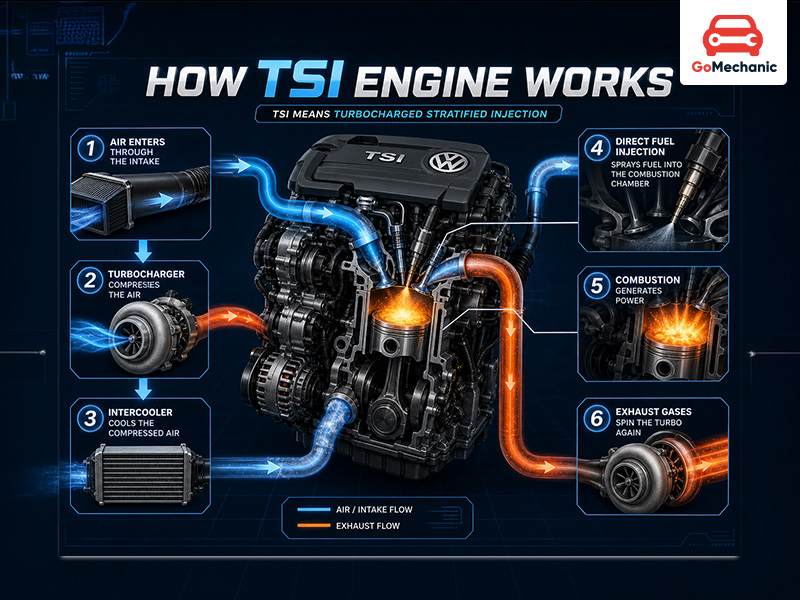
A TSI engine works by combining two key technologies, turbocharging and direct fuel injection. First, the turbocharger compresses air and pushes more oxygen into the engine. This allows the engine to burn more fuel efficiently, resulting in higher power output. Even a small engine can perform like a bigger one because of this.
Second, the direct fuel injection system sprays fuel directly into the combustion chamber instead of the intake manifold. This improves combustion efficiency, reduces fuel wastage, and enhances mileage. The combination of these systems ensures:
- Better acceleration
- Improved fuel efficiency
- Reduced emissions
Overall, the working of a TSI engine makes it more advanced compared to traditional petrol engines.
Advantages of TSI Engines
- TSI engines have gained popularity because they offer several practical benefits for everyday driving.
- One of the biggest advantages is higher power output. Even smaller TSI engines deliver strong performance, making them fun to drive. The turbocharger helps in quick acceleration, which is useful in both city overtakes and highway driving.
- Another key benefit is better fuel efficiency. Since fuel is injected directly and burned more efficiently, TSI engines consume less fuel compared to conventional petrol engines of similar power.
- TSI engines are also known for smooth performance. The power delivery is consistent, and there is less engine noise compared to older engines.
- Additionally, they are compact and lightweight, which helps improve overall vehicle efficiency and handling.
Disadvantages of TSI Engines
- While TSI engines offer many benefits, they also come with a few drawbacks that you should consider.
- One major concern is higher maintenance cost. Since TSI engines use advanced technology, repairs and servicing can be more expensive than regular petrol engines.
- Another disadvantage is turbo lag. Although modern engines have reduced this issue, there can still be a slight delay in power delivery at very low speeds.
- TSI engines may also require high-quality fuel for optimal performance. Using poor-quality fuel can affect efficiency and long-term reliability.
- Lastly, repair complexity is higher. Not all local mechanics may be fully equipped to handle TSI engine issues, which means you may need to rely on authorised service centres.
Related blog: MUV Full Form and Its Role in Cars
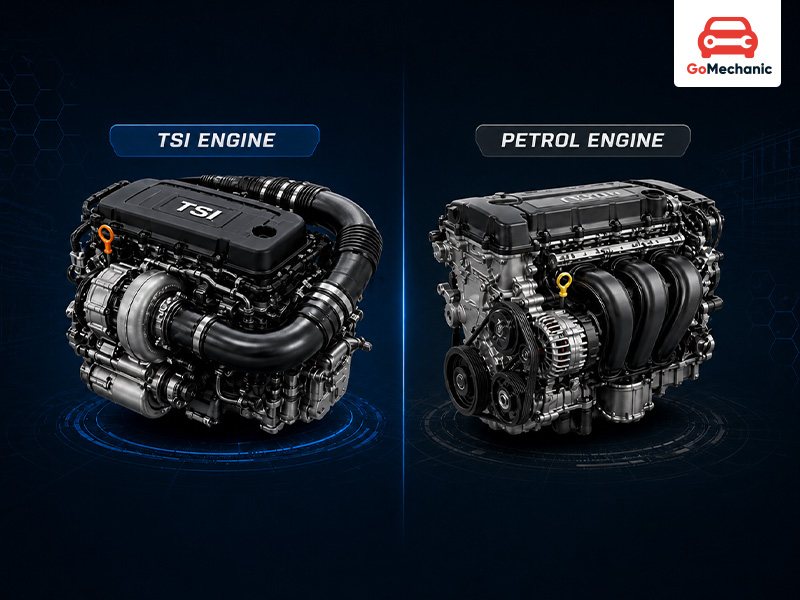
TSI vs Petrol Engine: Comparison Table
| Feature | TSI Engine | Regular Petrol Engine |
| Technology | Turbocharged + Direct Injection | Naturally Aspirated |
| Power Output | Higher | Moderate |
| Fuel Efficiency | Better | Average |
| Performance | Strong acceleration | Smooth but less powerful |
| Maintenance Cost | Higher | Lower |
| Driving Experience | Sporty & responsive | Comfortable & simple |
| Engine Size | Smaller but powerful | Larger for same power |
Is TSI Good for India?
TSI engines are actually quite suitable for Indian driving conditions, but it depends on how you use your car.
- For city driving, TSI engines perform well because they offer good mileage and smooth performance in traffic conditions. The smaller engine size also helps in better fuel efficiency during daily commutes.
- For highway driving, TSI engines really shine. The turbocharger provides strong power for overtaking and maintains stability at higher speeds. This makes long drives more comfortable and enjoyable.
- However, in India, factors like fuel quality and maintenance infrastructure play an important role. In metro cities, where fuel quality is better and service centres are easily available, TSI engines are a great choice.
- In smaller towns, you may need to ensure proper servicing and fuel quality to maintain engine performance.
Should You Buy a TSI Car?
Deciding whether to buy a TSI car depends on your driving needs and budget.
- If you are someone who enjoys performance, quick acceleration, and smooth driving, a TSI car is definitely a great option. It offers a premium driving experience and feels more responsive compared to regular petrol engines.
- TSI cars are also ideal for people who do a mix of city and highway driving, as they provide both efficiency and power when needed.
- However, if your priority is low maintenance and budget-friendly ownership, a regular petrol engine might be a better choice. TSI engines can cost more in terms of servicing and repairs.
- So, if you are willing to invest a bit more for better performance and technology, buying a TSI car is absolutely worth it.
Do read: DCT Full Form in Cars: Meaning, Working, and Benefits Explained
Conclusion
Understanding the TSI full form helps you get a clear idea of how modern engine technology is improving both performance and efficiency. TSI engines combine turbocharging and direct fuel injection to deliver a powerful yet fuel-efficient driving experience. They are well-suited for Indian roads, especially in urban areas and highways, where their performance can be fully utilised. While they may come with slightly higher maintenance costs, the overall driving experience they offer makes up for it.
If you are looking for a car that feels smooth, responsive, and efficient, a TSI engine is definitely a strong contender. With the right care and proper servicing, it can provide a reliable and enjoyable driving experience for years.
FAQs
Which is better, TDI or TSI?
The comparison between TDI and TSI depends on which function you need to use. TDI engines deliver superior fuel efficiency for extended road trips while TSI engines provide greater driving comfort and improved vehicle operation. The TDI option provides better fuel consumption while TSI delivers greater engine power and vehicle refinement. The choice depends on your usage.
Is TSI always petrol?
TSI refers to petrol engines. TSI engines developed by Volkswagen use Turbocharged Stratified Injection technology as their core engine design. The technology uses turbochargers to deliver increased engine performance and fuel efficiency. TSI operates exclusively as a petrol engine technology. Diesel engines use TDI technology instead.
What is the average lifespan of TSI engines?
A TSI engine which receives proper maintenance can operate between 150000 to 200000 kilometers or beyond that distance. People need to establish regular servicing schedules and use high-quality fuel while practicing correct driving techniques. Turbo engines need timely maintenance to stay reliable. The engine requires basic maintenance to achieve the same lifespan as contemporary engines.
Which engine performs better between TDI and GTI?
GTI vehicles achieve greater speed than TDI engines. GTI cars are performance-focused petrol vehicles with higher power and quicker acceleration. TDI engines concentrate on producing torque and achieving fuel efficiency rather than reaching high speeds. The performance of GTI vehicles establishes them as superior to other options.
Are TSI and turbo the same?
The two elements do not share identical characteristics. TSI represents a petrol engine design which combines turbocharging with direct fuel injection. Turbo functions as a device which increases engine output. TSI engines use turbocharging as their standard feature while turbo engines exist beyond that system.