GoMechanic





Tyres are easily the most ignored part of car ownership in India, and you see it everywhere once you start noticing. People will debate engine oil brands for twenty minutes, argue about petrol versus diesel like it is a personality trait, but ask them their tyre pressure and you will mostly get a confused look, followed by a topic change. Tread depth? Forget it. Most owners have never once crouched down and actually looked at their tyres outside of a puncture situation.
The thing about tyres is that they do not fail loudly at first. The wrong tyre size quietly changes how the car handles without you having a clear before-and-after to compare against. Pressure that is a few PSI off keeps eating into mileage without triggering any dashboard light. Delayed replacement just sits there, getting closer to being a problem, until one afternoon on a highway it stops being something you can deal with later. Most tyre failures in India are not random bad luck. They are ignored, and maintenance is catching up.
The Nissan Magnite is a car that punched above its weight at launch and built a loyal owner base because of it. People who buy a Magnite are generally paying attention to what their car does. Getting the Nissan Magnite tyre size right is part of that, because whatever Nissan engineered into the chassis and suspension is only as good as the rubber connecting all of it to the road. A properly specced tyre at the right pressure is what lets the car actually behave the way it was designed to.
This blog covers everything that actually moves the needle. How to read the tyre size code on your sidewall without guessing, which size applies to your specific variant, correct pressure figures in both PSI and BAR, realistic replacement costs by brand, the early warning signs most people drive past, and what tyre care actually looks like in practice for a car that lives on Indian roads year-round.
How to Read Your Nissan Magnite Tyre Size Number
That number on your tyre sidewall, something like 195/60 R16, looks complicated at first glance. Most people ignore it, honestly. But the moment you don’t know it, the tyre shop conversation starts slipping out of your control. Spend two minutes understanding it once, and you won’t get pushed into the wrong choice again.
Take 195/60 R16, which is the common Nissan Magnite tyre size across most variants. The 195 is the width of the tyre in millimetres, basically how wide it sits on the road. More width usually means better grip, but also a bit more resistance while rolling. The 60 is where people get confused. It is not 60 mm, it is 60 per cent of 195, so roughly 117 mm of sidewall height. The higher profile feels softer over bumps, the lower profile feels sharper but also harsher on bad roads.
The R simply means radial, nothing fancy there because every modern tyre uses it. The 16 at the end is the wheel size in inches, and this is the part you cannot mess with. A 16-inch tyre will not fit on a 15-inch wheel, no workaround, no jugaad. Still, some shops try to suggest “close enough” sizes when stock is limited, so this is where knowing your spec actually saves you.
Now here is where it gets serious. Changing the Nissan Magnite tyre size even slightly changes the rolling of the tyre, how far it travels in one rotation. That affects your speedometer reading, your odometer accuracy, even how ABS reads wheel speed. The car won’t warn you about it, it just behaves a little off, and most people never realise why.
Variant-wise Nissan Magnite Tyre Size Breakdown
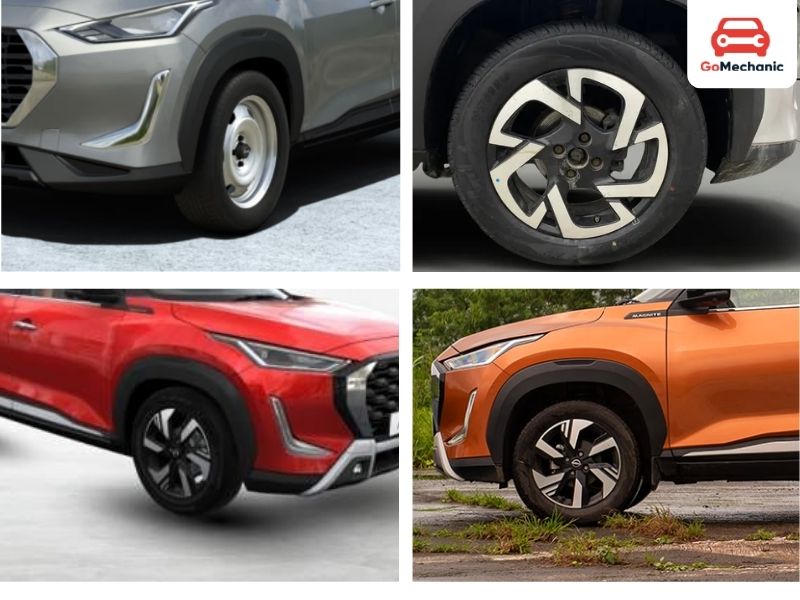
The Magnite does not run one tyre size across the entire range, and this is where owners get caught out at the tyre shop. Lower variants and higher variants use different wheel and tyre specifications, and assuming yours is the same as what the shop has in stock is how you end up with rubber that does not match what Nissan designed the car around.
Variant-wise Nissan Magnite tyre size reference:
| Variant Group | Engine | Tyre Size | Wheel |
| XE, XL | 1.0L NA Petrol | 195/60 R16 | 16-inch steel |
| XV, XV Premium | 1.0L NA Petrol | 195/60 R16 | 16-inch alloy |
| Turbo XL, Turbo XV | 1.0L Turbo Petrol | 195/60 R16 | 16-inch alloy |
| Turbo XV Premium, Turbo TOP | 1.0L Turbo Petrol | 205/60 R16 | 16-inch alloy |
Confirm your exact tyre size on the sticker inside the driver’s door jamb before purchasing
The practical difference between 195/60 R16 and 205/60 R16 is 10mm of additional width. That wider tyre on the top turbo variants gives a slightly more planted feel at speed and marginally better lateral grip, which matters more on a car with the turbo’s performance headroom. For city and mixed driving, both sizes perform well. What matters is knowing which one your car left the factory with, because fitting a 205 on a car calibrated for 195 changes the rolling circumference enough to affect the speedometer and ABS calibration in ways that are not immediately obvious but are consistently present.
Do not let a tyre shop talk you into a different size because they do not have your exact specification in stock. Getting the correct Nissan Magnite tyre size ordered in takes a day at most from any serious shop. It is worth the wait.
Nissan Magnite Tyre Pressure and Why It Matters
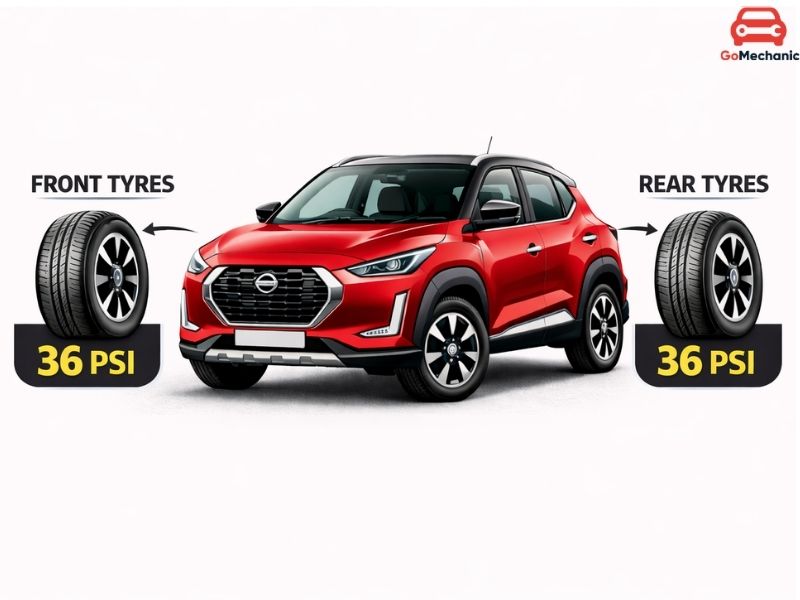
Tyre pressure is the maintenance item that costs nothing to get right and has the widest impact when it is wrong. The recommended Nissan Magnite tyre pressure for normal driving conditions is 32 to 33 PSI cold, which is 2.2 to 2.3 BAR. Normal here means up to three occupants with light luggage. When the car is genuinely loaded for a highway trip, four or five people plus bags, increase to 35 to 36 PSI, or 2.4 to 2.5 BAR, then come back down once you are back to regular use.
Nissan Magnite tyre pressure reference:
| Load Condition | Front (PSI) | Rear (PSI) | Front (BAR) | Rear (BAR) |
| Normal load (up to 3 occupants) | 32 – 33 | 32 – 33 | 2.2 – 2.3 | 2.2 – 2.3 |
| Full load (4 – 5 occupants + luggage) | 35 – 36 | 35 – 36 | 2.4 – 2.5 | 2.4 – 2.5 |
Check the pressure cold, before the car has been driven. Hot tyre pressure reads 2 to 3 PSI higher than cold, giving a false reading.
Running even 5 PSI below the recommended Nissan Magnite tyre pressure is not a small deal. A soft tyre flexes more with every rotation than it was built to handle, which generates heat inside the casing. In Indian summer conditions, a tyre running low that then hits a highway pothole at speed is carrying real blowout risk rather than a theoretical one. The fuel economy effect is less dramatic but more constant: low pressure means the engine is working against extra rolling resistance every single kilometre, and over a month of commuting, that adds up to a meaningful difference on the petrol bill even if no single fill feels noticeably worse.
Over-inflation gets talked about less but causes its own specific damage. A tyre pumped well above spec rides on a narrow central strip of tread rather than the full contact width. The centre wears out while the edges look fine, which means you end up replacing tyres that appear to have life left because the centre has gone. Wet grip also drops because less rubber is actually touching the road, which, on monsoon roads, is precisely when you want maximum contact. Check the Nissan Magnite tyre pressure cold once a month. It takes four minutes with a basic gauge, and it genuinely extends tyre life more than any other single habit.
Nissan Magnite Tyre Price: What to Budget for a Replacement
| Brand | Price Range | Best For |
| CEAT SecuraDrive | ₹5,000 – ₹6,500 | City-heavy use, value-conscious buyers |
| Apollo Alnac 4G | ₹5,200 – ₹6,800 | Mixed city and highway, good wet grip |
| MRF ZV2K / Wanderer | ₹6,000 – ₹7,500 | All-round reliability, wide availability |
| Goodyear Assurance | ₹6,500 – ₹8,000 | Highway comfort, decent tread life |
| Bridgestone Turanza | ₹8,000 – ₹10,000 | Highway performance, longer lifespan |
| Michelin Energy XM2+ | ₹9,000 – ₹12,000 | Best wet grip, longest tread warranty |
Conclusion
The Nissan Magnite tyre size question has a straightforward answer once you know your variant: 195/60 R16 for most of the range and 205/60 R16 for the top turbo variants. Write that number in your phone right now, because having it when you walk into a tyre shop changes every part of that conversation. You stop being someone to quote and start being someone who already knows what they need.
Pressure is the maintenance habit with the lowest effort and the widest return. Thirty-two to thirty-three PSI cold for normal use, up to thirty-five to thirty-six when fully loaded, checked monthly before the car has been driven. The TPMS light is not a pressure monitoring system; it is a low-pressure alarm. By the time it comes on, the tyre has already been running soft long enough to have taken wear. Do not use it as your indicator.
For replacement, the mid-range brands handle most Magnite owners’ real-world use well. If you clock over 1,500 km a month consistently or spend meaningful time on expressways, Bridgestone or Michelin will return better value over the tyre’s full life. Whatever you buy, get alignment done at the same time. GoMechanic covers the full job with transparent pricing upfront, fitting, balancing, and alignment included, so the bill at the end matches the number you agreed to at the start.
FAQ’s
1. What is the tyre pressure for a Nissan Magnite?
For normal daily use, the Nissan Magnite tyre pressure sits around 32 to 33 PSI when checked cold. That works for city driving with a light load. If the car is fully loaded for a trip, you go slightly higher, around 35 to 36 PSI. Small difference on paper, but it changes how the car feels and wears over time.
2. Which tyre is best for Nissan Magnite?
There is no one perfect tyre; it depends on how you drive. For mostly city use, CEAT or Apollo works fine and keeps costs in check. If you do highway runs often, then Bridgestone or Michelin starts making more sense. You pay more upfront, but the grip and life usually balance it out.
3. Is Nissan Magnite a good car to buy?
Magnite built its value because it offers more than expected at its price point. It works well for city use, has decent features, manageable running cost. Just keep the basics like tyre size and pressure right, and the car behaves the way it should.
4. What is the cost of one tyre?
A single Magnite tyre usually falls between ₹5,000 and ₹12,000, depending on brand and type. Budget options handle basic use well, nothing fancy, but gets the job done. Premium tyres cost more, but they last longer and handle better, especially in rain and highway speeds.
5. Is Nissan a Japanese car brand?
Yes, Nissan is a Japanese car manufacturer; that part is straightforward. But what matters more for buyers here is how the car is tuned for Indian roads. The Magnite is built keeping local conditions in mind, which is why things like tyre spec and pressure matter more than brand origin.